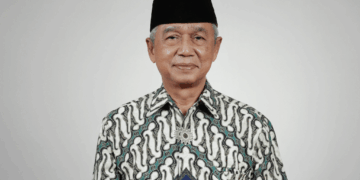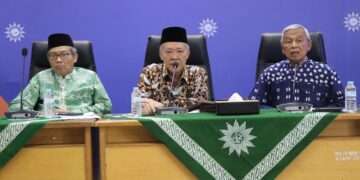
EN.MUHAMMADIYAH.OR.ID, YOGYAKARTA – Busyro Muqoddas, Chairperson of the Central Board of Muhammadiyah, has warned that Indonesian democracy faces serious challenges from the growing influence of oligarchy, feudalistic culture, money politics, and corruption in leadership.

He said elections, which should serve as an instrument of popular sovereignty, risk becoming a means for political elites and financial backers to reproduce and consolidate their power.
Busyro delivered these remarks at a national seminar titled “Democracy, Elections, and National Leadership,” organized by the Faculty of Social and Political Sciences at Muhammadiyah University of Yogyakarta (UMY) on Thursday (19/11) at the University’s postgraduate amphitheater.
According to Busyro, one of the fundamental problems facing Indonesian democracy is the growing influence of feudalistic culture, which goes hand in hand with a crisis of meritocracy and weak political party cadre development.
These conditions also weaken democracy within legislative institutions, including through the growing cult of personality in the House of Representatives (DPR). Meanwhile, money politics in regional elections further entrenches patronage and encourages public tolerance of bribery.
“Our democracy faces serious problems. Feudalistic culture is growing stronger, meritocracy is in crisis, and political parties are falling to develop their cadres properly. Under these circumstances, democracy loses its substance because patronage and personality cults increasingly determine who holds power,” he said.
Corruption Goes Beyond Stealing Public Money
Busyro also highlighted leadership corruption as a problem that extends beyond the abuse of authority or embezzlement of public funds. Leadership corruption occurs when people lose their substantive right to elect leaders who are honest, intelligent, and have a clear record of moral integrity.
“Corruption does not occur only when someone steals public money. Leadership corruption also occurs when people are deprived of their right to have leaders who are honest, intelligent, and possess a sound moral record. This is a fundamental problem in our democratic life,” Busyro said.
He also criticized what he described as constitutional corruption, citing Constitutional Court Decision No. 90/PUU-XXI/2023 concerning the age requirement for vice-presidential candidates. He pointed to the case as an example of serious concerns over the integrity of state institutions and the practice of constitutional democracy.
Furthermore, Busyro linked problems in democracy and national leadership to state capture corruption, a situation in which certain economic and political interests exert influence over state institutions and decision-making processes.
Oligarchs are Devouring People’s Sovereignty
Busyro argued that political parties and the DPR should serve as democratic institutions and channels for popular sovereignty. However, when oligarchic groups and financial interests control them, democracy becomes a tool for preserving the power of a small political elite.
He also stressed that conflicts and humanitarian tragedies in various parts of Indonesia must be examined in connection with problems in power governance and development policies. During his presentation, Busyro referred to several conflict-affected areas, including regions associated with National Strategic Projects (PSN).
Among the measures he proposed was a fundamental revision of the Political Parties Law and the Regional Head Elections Law. He also recommended issuing a Government Regulation in Lieu of Law (Perppu) to restore the legal framework for eradicating corruption to Law No. 30 of 2002 on the Corruption Eradication Commission (KPK), as well as halting National Strategic Projects.
“Democratic reform cannot stop at changing those in power through elections. We need fundamental changes to the political system, particularly by reforming political parties and the organization of regional elections. Civil society must play an active role in pressing for these changes,” he stressed.
For Busyro, democratic reform requires more than holding elections according to procedural rules. Democracy must ensure that popular sovereignty genuinely shapes decision-making, leadership recruitment, and the administration of government.
Strengthening the integrity of political parties, state institutions, and national leadership is essential to restoring democracy to its constitutional purpose: protecting the people, ensuring justice, and preventing a small elite from monopolizing power.