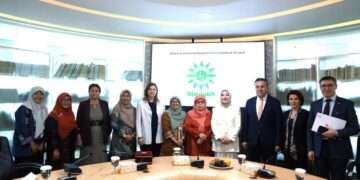
MUHAMMADIYAH.OR.ID, YOGYAKARTA – The Central Board of ‘Aisyiyah held an Islamic study session titled “Preventing and Addressing Women and Child Grooming: The Perspective of Progressive Islam.” The event also served as a moment to commemorate International Women’s Day, observed on March 8, 2026.

Opening the session, Prof. Casmini, Chairperson of the Tabligh and Religious Affairs Council of ‘Aisyiyah Central Board, emphasized that the discussion was intended as a collective reflection to strengthen the propagation of progressive Islamic values while raising awareness about protecting the dignity of women and children from various forms of social vulnerability.
According to her, Islam functions as a moral and spiritual force that upholds human dignity. Therefore, religious outreach must be able to respond to contemporary challenges, including the prevention and handling of manipulative relationships or grooming that harm women and children.
“Islam stands as a moral and spiritual force to protect human dignity. This becomes a shared responsibility in our da’wah efforts so that we can respond to contemporary issues, including preventing and addressing manipulative relationships that harm women and children,” Casmini said during the event held on Saturday (7/3).
Grooming from the Perspective of Progressive Islam
In her presentation, Evi Sofia Inayati, Chairperson of the Central Board of ‘Aisyiyah, explained that unequal power relations leading to grooming practices have existed since ancient times, including during the pre-Islamic jahiliyah era.
She cited the historically unequal relationships between rulers and slaves as an example of injustice that Islam sought to challenge from its earliest days.
“From the beginning, Islam has defended vulnerable groups by exposing unjust practices. Islam brought a real breakthrough against various forms of unequal relationships that harm humanity,” she said.
Evi referred to the Fiqh of Child Protection, which emphasizes three core values: tawhid (the oneness of God), justice, and public welfare or compassion (rahmah). In Muhammadiyah’s perspective, Islamic jurisprudence does not merely deal with legal rulings of halal and haram, but also encompasses broader humanitarian values.
“Women and child grooming is an act of injustice and a crime against humanity. Therefore, efforts to prevent and address it must become a shared concern,” she stressed.
She added that protecting women and children is a religious obligation that must be carried out collectively by families, communities, educational institutions, religious organizations, and the state.
Grooming Threats in the Digital Era
Meanwhile, Tsabita Ikrima Al Arify, Secretary General of the Central Board of Muhammadiyah Student Association (Ikatan Pelajar Muhammadiyah/IPM), described the realities faced by young people regarding grooming in the digital age.
She explained that today’s generation lives in two spaces simultaneously: the physical world and the digital world. Emotional connections on social media can form quickly, even with people who are not personally known.
“This situation opens opportunities for grooming, especially since many social media users have multiple accounts, making it difficult to identify their real identities,” Tsabita explained.
She noted that grooming usually develops gradually through seemingly ordinary interactions that later evolve into emotional manipulation.
“Most grooming cases occur between significantly older individuals and younger children. This indicates an unhealthy relationship, as grooming often begins with manipulative narratives and interactions,” she said.
Tsabita also emphasized that social media must become an important arena for prevention efforts, as many members of Generation Z and Generation Alpha interact primarily in digital spaces.
For this reason, she believes organizations such as Muhammadiyah and ‘Aisyiyah have a strategic role in promoting educational narratives and prevention campaigns against women and child grooming through social media platforms.
“If young people spend much of their time in digital spaces, then education and prevention efforts must also be present there. This is where ‘Aisyiyah’s role becomes crucial in spreading grooming prevention narratives on social media,” she concluded.
Through this discussion, ‘Aisyiyah hopes that public awareness will grow stronger, emphasizing that preventing women and child grooming is a shared responsibility in creating a safe and dignified environment for women and children.