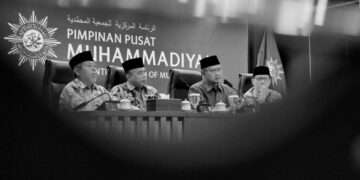
EN.MUHAMMADIYAH.OR.ID, YOGYAKARTA – Muhammadiyah President Haedar Nashir has called on the organization to expand its international presence by strengthening its institutions, education programs, and community empowerment initiatives. He emphasized that Muhammadiyah’s dakwah should reach people across nations through tangible contributions that resonate with diverse communities.

Haedar made the remarks in an interview on the Pecah Telur YouTube channel on Wednesday (18/11). He explained that Muhammadiyah’s internationalization followed a mandate from its 2015 National Congress in Makassar, which the organization has since pursued through several strategic initiatives.
The first step involved strengthening Muhammadiyah Special Branch Boards (PCIM) in various countries. These branches serve as Muhammadiyah’s ambassadors while developing initiatives that integrate with the social and cultural life of their respective countries.
Muhammadiyah has also worked to secure legal recognition for its institutions in several countries, allowing them to operate more freely. These efforts have included establishing legal entities in Germany, Australia, the United States, and Taiwan.
Beyond organizational development, Muhammadiyah has begun establishing educational and dakwah institutions overseas. In Egypt, the organization operates a dakwah center and an Aisyiyah Kindergarten (TK ABA). It has also developed Muhammadiyah Australia College, which has received accreditation and government subsidies from Australia, as well as Universiti Muhammadiyah Malaysia in Perlis.
“This is how Muhammadiyah makes its presence felt, not through speeches or debate forums, but through educational institutions that can adapt to, gain acceptance from, and integrate with the systems in each country,” Haedar explained.
He hopes these institutions will help promote a moderate understanding of Islam (Islam wasatiah) that emphasizes peace, humanity, and respect for differences. Through tangible contributions to education and social services, Muhammadiyah aims to engage in meaningful dialogue with people from different nations.
Empowering Communities through Entrepreneurship
During the interview, Haedar also encouraged the public, particularly young people, to develop an entrepreneurial spirit and support micro, small, and medium-sized enterprises (MSMEs). He noted that small-scale entrepreneurs need guidance and support to grow their businesses and achieve independence.
“We should always do whatever we can and never put it off. People in our communities who sell meatballs, run small food stalls, work as small-scale farmers or fishermen, and everyone else struggling to make a living need companions, mentors, and people who can empower them,” he said.
Haedar believes community empowerment should focus on strengthening people’s capabilities so they can develop their own businesses. He compared this approach to giving people fishing rods rather than simply handing them fish, enabling them to sustain their livelihoods independently.
He also welcomed the establishment of the Muhammadiyah Business Association (Syarikat Usaha Muhammadiyah), which he hopes will consolidate the entrepreneurial potential of Muhammadiyah members, particularly young business owners. Through business networks, the organization can encourage productivity, economic independence, and collaboration across Indonesia.
Upholding Sincerity and Commitment in Organizational Service
Haedar also reminded Muhammadiyah members to preserve sincerity in organizational service. He stressed that leadership positions within Muhammadiyah represent a trust, not an opportunity to pursue personal interests. When someone receives a mandate and has the ability to carry it out, they must fulfill that responsibility wholeheartedly.
He said the dedication shown by Muhammadiyah activists across the country, including those who serve their communities despite limited resources, should inspire others to keep contributing. Leaders and cadres must also maintain a commitment to learning so they can broaden their perspectives and respond to changing times.
Haedar urged Muhammadiyah members and the wider public to expand their dakwah efforts, avoid rigid or exclusive attitudes, and build cooperation to address shared challenges.