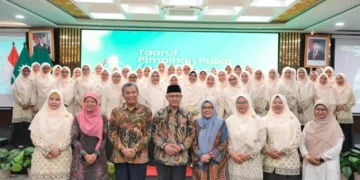


MUHAMMADIYAH.OR.ID, BANDUNG – Former Vice President of Indonesia, Jusuf Kalla (JK) attended and delivered a testimonial speech at Muhammadiyah’s 113th Anniversary celebration at Muhammadiyah University of Bandung (UMB) on Tuesday (18/11).

In his address, JK highlighted Muhammadiyah’s important role in education and social welfare, and urged the organization to strengthen the spirit of entrepreneurship among its cadres.
JK opened his remarks by sharing a personal story about his background in wasatiyah (moderation). He explained that he grew up in a diverse household. His father was a treasurer of Nahdlatul Ulama and his mother was a treasurer of ‘Aisyiyah. This upbringing shaped him into someone who actively participated in many circles, including Muhammadiyah, which he chose because it had “more activities”.
He congratulated Muhammadiyah for reaching 113 years, calling it an extraordinary achievement, as very few organizations survive beyond several decades.
JK praised Muhammadiyah’s rapid growth, even calling it one of “the wealthiest religious organizations in the world.” He recalled once being invited to observe research on Muhammadiyah’s assets, but the sheer amount of property and institutions made it difficult to calculate.
He emphasized that Muhammadiyah’s work aligns with the constitutional goal of ensuring the nation’s intellectual advancement. Today, Muhammadiyah plays a major role in education, from schools and pesantren (Islamic boarding school) to universities. JK noted that Muhammadiyah operates nearly 170 hospitals close to 180 universities, which is an outstanding achievement.
Despite these accomplishments, JK pointed out a gap in spirit. He questioned who generates value, initiates meetings, and drives economic activity. The answer, he said, is entrepreneurs.
For that reason, progress and growth must be accompanied by a “strong entrepreneurship spirit.” JK reminded that Prophet Muhammad himself was an entrepreneur from the age of 13 to 40. Thus, Muhammadiyah should follow the prophet’s example by encouraging its members to embrace entrepreneurship.
He shared the story of a Muhammadiyah cadre who dropped out of university but chose to become a businessperson, and is now “more successful than many graduates.”
KL also emphasized Muhammadiyah’s desire to advance welfare and instill a “never-give-up spirit” in its members. He often notes that Muslims are encouraged to fulfill the five pillars of Islam with strong capability. Islam encourages its followers to be economically stable, not necessarily wealthy, but at least stable. Without economic stability, a person can only fulfill three out of the five pillars. (Bintang Adrian)