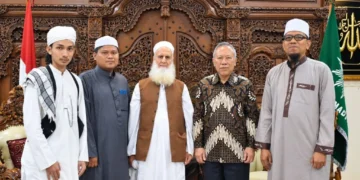


EN.MUHAMMADIYAH.OR.ID, JAKARTA – The Central Board of Muhammadiyah received Palestinian Ambassador to Indonesia Abdulfattah A.K. Al-Sattari at its Jakarta Headquarters on Monday (10/8).

The ambassador was received by Chairperson Syafiq Mughni and International Relations and Cooperation Department (LHKI) Secretary Yayah Khisbiyah.
The Palestinian Ambassador expressed appreciation for Muhammadiyah’s support for the Palestinians and their struggle. He said such support forms an important part of the longstanding friendship between the two countries.
The conditions facing Palestinians, particularly in Gaza and the West Bank, were a central concern during the meeting. Palestinians continue to face prolonged occupation, settlement expansion, attacks and bombardment, displacement, and restrictions on access to healthcare and medical evacuation.
Chairperson Syafiq Mughni said Muhammadiyah would continue strengthening its support for Palestinians through a range of partnerships. One such effort involves education, including scholarships for Palestinian students to study at Muhammadiyah-affiliated Universities.
“This is what we did. We provide scholarships with the approval of the Palestinian Embassy. We hope more Palestinian students will come to study at Muhammadiyah Universities,” Syafiq said.
Meanwhile, Yayah Khisbiyah, secretary of LHKI, said Muhammadiyah’s support for Palestine now extends beyond humanitarian aid. The organization is developing programs focused on community empowerment, peacebuilding, psychological resilience and education.
Beyond Humanitarian Aid
“Perhaps, what is new is that we are identifying forms of assistance beyond the humanitarian aid that is commonly provided, such as staple foods, medicine, medical personnel, and shelters for displaced people. Sometimes, we also provide support for mosques and, of course, hospitals,” Yayah said.
Muhammadiyah has developed economic empowerment programs, particularly for women affected by war. These initiatives aim to help survivors sustain their livelihoods and rebuild economic independence amid prolonged conflict.
Since 2024, Muhammadiyah has also developed a peacebuilding program for young Palestinians. The initiative is part of the organization’s efforts to help younger generations and understand the conflict and explore peaceful ways to resolve it.
The peacebuilding program will continue to expand, with greater emphasis on psychological resilience. The prolonged war has taken a heavy psychological toll on Palestinians. For some, the pressure has even fueled a desire to leave their homeland.
The resilience program therefore seeks to help Palestinians cope with stress and depression while maintaining their determination to remain and build a future for Palestine.
“People’s psychological resilience has been attacked so severely that many want to leave Palestine. If they leave and the land becomes empty, it will naturally become easier to take. That is why we are developing resilience programs to help people cope with stress and depression while maintaining their spirit of resistance,” Yayah said.
Muhammadiyah also provides psychosocial support for young people and women who have survived the war. The program also reaches cancer survivors, as the conflict and its consequences have heightened health risks.
“In addition, we provide psychosocial support for young people, mothers who have been affected by the war, and survivors of war, including cancer survivors,” Yayah said.
Expanding Scholarships for Palestinian Youth
Another key issue discussed at the meeting was expanding educational opportunities for Palestinian young men and women through Muhammadiyah and ‘Aisyiyah Higher Education Institutions (PTMA).
Yayah said PTMA institutions host a substantial number of international students. However, the number of Palestinian students remains relatively small compared with students from countries such as Thailand and Sudan.
Muhammadiyah therefore sees a need to expand scholarship opportunities for Palestinian students seeking to study at PTMA institutions.
“Finally, we need to increase the number of scholarships for Palestinian young men and women at PTMA institutions. We have many international students, but the number of Palestinian students remains small compared with students from countries such as Thailand, Sudan and others,” Yayah said.
Expanding scholarships is expected to form part of Muhammadiyah’s long-term support for Palestine. Education is not only a means of strengthening young people’s capabilities but also an investment in Palestine’s future.
Through their education at PTMA institutions, Palestinian students are expected to gain knowledge and skills that they can eventually bring home to contribute to the development of their communities and country.
The meeting with the Palestinian ambassador also provided an opportunity to strengthen communication and coordination between Muhammadiyah and the Palestinian diplomatic mission in Indonesia. Future cooperation is expected to expand beyond humanitarian assistance to include economic empowerment, peacebuilding, psychological resilience, psychosocial support and education.
In this way, Muhammadiyah’s support for Palestine is increasingly shifting from an emergency response toward strengthening Palestinians’ capacity to endure, develop and prepare for their future amid a prolonged conflict.