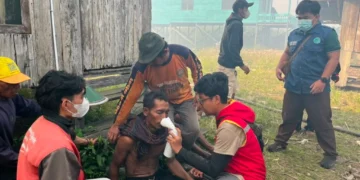


MUHAMMADIYAH.OR.ID, YOGYAKARTA — Vice Chairperson of the Council for Tarjih and Tajdid of Muhammadiyah Central Board, Mohammad Mas’udi, emphasized the importance of a clear religious stance that is humanitarian-oriented and free from non-social interests in responding to the flash floods and landslides that have struck several regions in Sumatra.

He delivered the remarks during his Friday sermon at the KH Ahmad Dahlan Mosque, Muhammadiyah University of Yogyakarta (UMY), on Friday (19/12).
Mas’udi explained that the issue of the Sumatra disaster was raised for at least two main reasons. First, there was a sudden invitation from the Central Board of Muhammadiyah to all Auxiliary Leadership Units (UPP), including councils, institutions, bodies, and autonomous organizations, to attend an in-person meeting at the PP Muhammadiyah Office.
A total of 39 UPPs were required to attend in order to align steps and understanding in responding to the disaster. “The invitation underscores that all Muhammadiyah resources must be present and moved together for disaster response,” he said.
Second, in his role as a leader of the Council for Tarjih and Tajdid, Mas’udi felt it necessary to briefly convey Muhammadiyah’s perspective on disaster jurisprudence as formulated by the Council for Tarjih and Tajdid together with the Muhammadiyah Disaster Management Center.
Humanitarian Focus Without Hidden Agendas
Mas’udi reiterated the message of Muhammadiyah Central Board President Haedar Nashir, emphasizing that Muhammadiyah is a socio-religious organization. Therefore, all actions in responding to the Sumatra disaster must be directed solely toward humanitarian interests.
“Haedar Nashir has strongly cautioned that this disaster response must not be infiltrated by elements outside social activities, especially political interests,” he stressed.
According to Mas’udi, Muhammadiyah has chosen to focus on emergency response and long-term recovery, particularly in Aceh, North Sumatra, and West Sumatra, where the impacts are expected to last for a considerable time. He also warned against the emergence of dissenting voices that could weaken Muhammadiyah’s collective efforts while the organization is actively assisting affected communities.
Muhammadiyah Perspective on Disaster Jurisprudence
From Muhammadiyah’s disaster jurisprudence perspective, disasters are understood as part of God’s decree and should be met with faith and surrender. “When a disaster occurs, what we should say is inna lillahi wa inna ilaihi raji’un. Everything belongs to God, and to Him we return,” he said.
Mas’udi emphasized that disasters are not curses or divine punishment, but trials that carry wisdom beyond what is immediately visible. He cited the Aceh tsunami as an example, an event that, despite immense suffering, also led to hidden blessings in the form of peace and stronger integration of Aceh within the Unitary State of the Republic of Indonesia.
Knowledge, Reflection, and Human Responsibility
Beyond being a test of faith, disasters should also serve as moments of self-reflection and introspection. As a progressive Islamic movement, Muhammadiyah encourages the use of scientific knowledge to understand and mitigate disaster risks.
Mas’udi distinguished between purely natural disasters and ecological disasters caused by human actions. He noted that flash floods in several parts of Sumatra cannot be entirely separated from human error. Nevertheless, Muhammadiyah has chosen not to be trapped in debates over causes, instead prioritizing emergency response and post-disaster recovery.
“The cost of recovery is far greater than that of emergency response. This is where Muhammadiyah has proven experience and capacity, recognized even at the global level,” he explained.
In closing his sermon, Mas’udi called on congregants, particularly the UMY academic community, to contribute to disaster relief efforts through almsgiving and donations, which can be channeled via Lazismu UMY.
“The message from the Central Board of Muhammadiyah is clear: focus on resolving the disaster. After that, other issues can be discussed,” he concluded.