
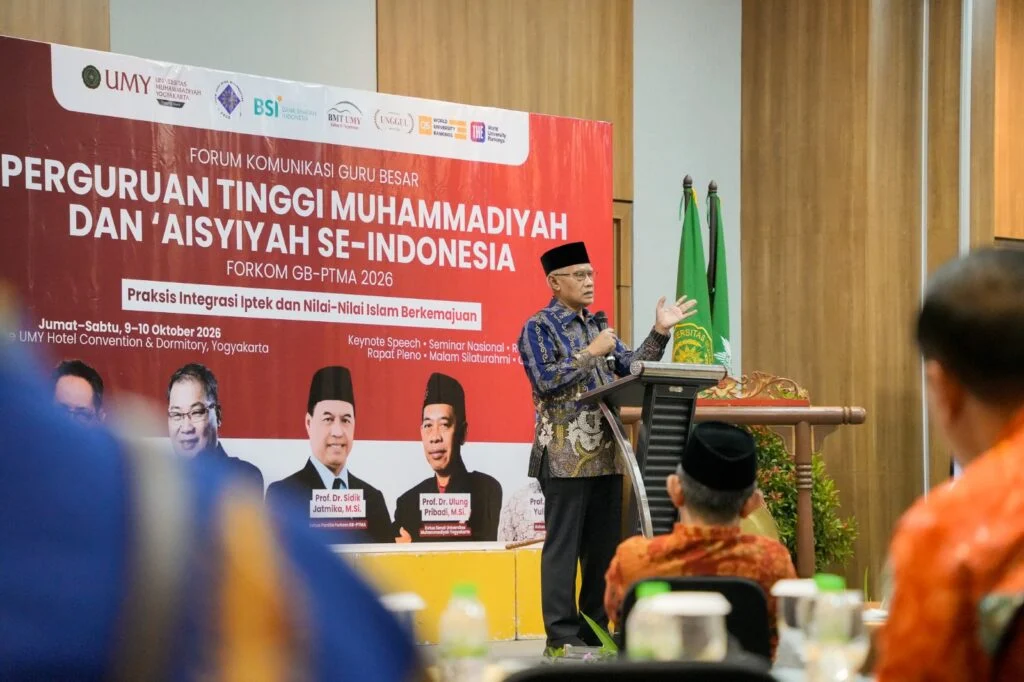
EN.MUHAMMADIYAH.OR.ID, YOGYAKARTA – The concept and practices of human rights and democracy in Indonesia need to be reconstructed in alignment with Pancasila, the nation’s founding values, as well as Indonesia’s history and original constitutional vision.

Haedar Nashir, President of Muhammadiyah, argued that Indonesia’s human rights and democracy have been practiced through an overly positivistic lens. He said these concepts should instead be aligned with Indonesia’s history and authentic foundations.
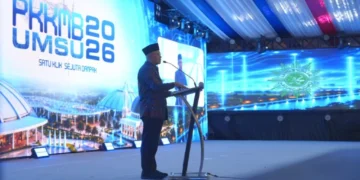
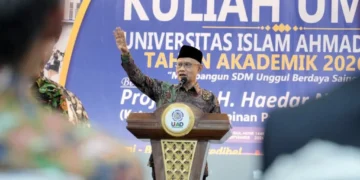
“In my view, the official model of Indonesian democracy in the fourth principle of Pancasila. ‘Democracy guided by the inner wisdom of deliberation among representatives of the people,’” Haedar said on Friday (9/10), at Muhammadiyah University of Yogyakarta
Reflecting on Indonesia’s history, Haedar observed that the nation had been too impatient in constructing its political system. Rather than selectively correcting existing arrangements, he argued, the country had instead dismantled the system as a whole.
Indonesia subsequently adopted a new system that, in his view, was ill-suited to the country’s foundations. He argued that this approach had persisted to the present day. Indonesia, he argued, keep giving rise to a liberal system that he blamed for various forms of moral decline. It includes the rise of many LGBT-related issues.
“If we do not begin reconstructing our concepts of human rights and democracy from the downstream end, things will continue as they are. Pancasila has already been officially established as our foundation. So why have we jumped ahead?” he said.
Building the Nation Without Causing Destruction
Haedar argued that adopting Western frameworks of thought wholesale, without critically examining the broader context of global politics, could create unintended consequences for Indonesia’s development. In his view, the consequences extend beyond damage to social norms and ethics.
He therefore called for Indonesia to be developed through a wasathiyah, or moderate and balanced, perspective grounded in the nation’s history and original foundations. Not everything, he argued, should be permitted, but neither should everything be prohibited.
“We should not suddenly allow ourselves to be controlled. The state must simply manage things properly. It must determine what needs to be preserved for future generations in the long term and what should be managed. There is a body of knowledge for doing that,” he said.
Haedar maintained that Indonesia’s natural resources, both beneath and above the ground, should be developed in accordance with the law, provided that their use serves the greatest possible prosperity of the people.
He said the management of Indonesia’s natural wealth was permissible as long as it benefited the public and did not cause environmental destruction.
“Let us use this as our foundation. The basic principle is to utilize natural resources, but we must set the concept straight. In pursuing prosperity through our natural resources, we must not exploit them recklessly. At the same time, we must not leave them entirely undeveloped,” he said.