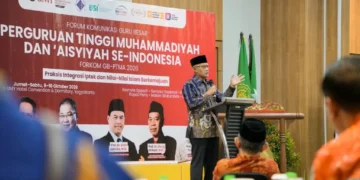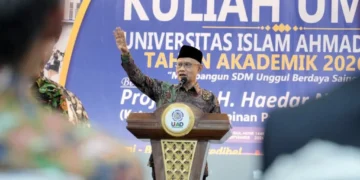


EN.MUHAMMADIYAH.OR.ID, YOGYAKARTA – Religious practices shaped by an overly rational outlook within Muhammadiyah should be balanced with the irfani approach, which emphasizes spiritual experience, intuition, moral sensitivity, and clarity of heart, known as al-’ilm al-hudhuri.

Haedar Nashir, President of Muhammadiyah, said Muhammadiyah’s Manhaj Tarjih employs three approaches: bayani (textual), burhani (contextual and rational), and irfani (intuition and inner experience). However, he said many Muhammadiyah members tend to place greater emphasis on the bayani approach,
“Sometimes, those who see themselves as leaders or preachers forget these three approaches. Some rely only on bayani and forget burhani. Others focus only on burhani and forget bayani. And some have both but forget irfani,” Haedar said on Saturday (29/8) during the graduation ceremony for students of the Muhammadiyah Ulama Higher Education at Muhammadiyah University of Yogyakarta (UMY).
Haedar says prioritizing only the bayani and burhani approaches while neglecting or weakening irfani could cause Muslim to lose the sense of feeling in their religious practice. This perception, he said, has often become the subject of jokes and even criticism directed at Muhammadiyah, which is sometimes regarded as overly rational and therefore unwilling to pray for those who have died.
Haedar rejected that assumption. Praying for the deceased, he said, is considered a sunnah or recommended practice in Muhammadiyah.
“We do not need to follow others who have various traditions. Instead, we should practice according to the Manhaj Tarjih. Prayer is a sunnah, and it has its own prescribed manner,” he said.
Haedar juga menampik anggapan, bahwa orang Muhammadiyah dilarang berduka atas meninggalnya seseorang, terlebih yang meninggal adalah sosok yang dicintai. Menurutnya, rasa duka itu lahir dari jiwa irfani manusia. Selain itu, rasa duka juga tidak menghilangkan tauhid kepada Allah Swt.
Mourning does Not Diminish Faith
“There is nothing wrong with Muhammadiyah members grieving when a beloved family member dies. Grief does not diminish our commitment to tawhid. And do not belittle those who grieve by saying, ‘Why are you so weak? Don’t be so emotional,’” Haedar said.
Haedar added that the irfani approach should also inform the spirit of amar ma’ruf nahi munkar, or encouraging what is good and preventing what is wrong. He urged Muhammadiyah members not to carry out amar ma’ruf nahi munkar solely through the bayani and burhani perspectives.