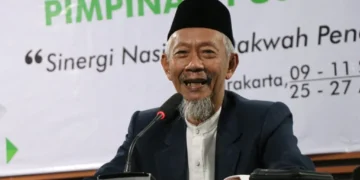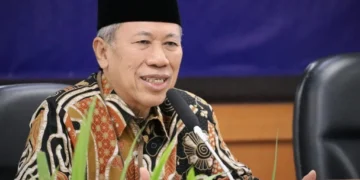


MUHAMMADIYAH.OR.ID, MADIUN – Haedar Nashir, President of the Central Board of Muhammadiyah, emphasized that the organization’s success in building charitable enterprises across various sectors demonstrates its enduring social and religious role since its founding more than a century ago.

He delivered the remarks at the inauguration of the AR-Fachruddin Building, the Darussalam Mosque, and the Ahmad Dahlan Building of Muhtadin Elementary School in Madiun on Saturday (September 6).
“Why has Muhammadiyah been able to achieve this? Because we have always contributed to building the nation and the state through positive engagement,” Haedar said.
Since its establishment in 1912, Muhammadiyah has pioneered charitable work in education, healthcare, social services, and other fields. Its achievements are rooted in strong human resources, extensive networks, and openness to collaboration with the government and other social movements.
Haedar stressed that Muhammadiyah’s spirit from the beginning has been not only to strive for independence but also to enrich that independence with progress. He reaffirmed Muhammadiyah’s commitment to the Indonesian state ideology of Pancasila, which it regards as darul ahdi wa syahadah—a noble consensus that must be lived through service and dedication.
“We are committed to upholding Pancasila as the foundation of the state. But commitment is not enough; it must be accompanied by concrete nation-building efforts,” he said.
Haedar also linked the vision of national progress with what Muhammadiyah calls Progressive Islam, grounded in the Qur’an. Citing Surah Al-Baqarah 2:143—“And thus We have made you a just and balanced community”—he underlined the importance of shaping a community that is moderate, fair, balanced, and exemplary. Such values, he said, should guide Indonesia to become an advanced, peaceful, and civilized common home.
He further referred to Surah Ar-Ra’d 13:11—“Indeed, Allah will not change the condition of a people until they change what is in themselves.” This message, he argued, must be translated into a work ethic, innovation, and resilience, so that genuine transformation emerges from collective effort, not just rhetoric.
“From this spirit, Muhammadiyah seeks to nurture a community committed to improving its destiny through hard work and real action,” Haedar explained.
According to him, Progressive Islam as lived by Muhammadiyah is not an abstract concept but a social praxis with tangible results. Over the past 113 years, Muhammadiyah has established thousands of schools, hospitals, and social institutions that benefit society at large.
This praxis orientation, he added, has earned Muhammadiyah global recognition. Today, Muhammadiyah is the only religious organization in Indonesia ranked among the world’s top four in terms of assets.
He also cited American anthropologist Robert Hefner, who observed that Muhammadiyah has succeeded in shaping a religious understanding rooted in social praxis. “Religion should not stop at doctrine, but must become a force that transforms reality,” Haedar noted.
He concluded by reaffirming that Muhammadiyah’s Social Enterprises are inspired by the spirit of Surah Al-Ma’un.
“Al-Ma’un has become our theological praxis—a theology where faith inspires social movements that build institutions for the welfare of the community and the nation,” he said.