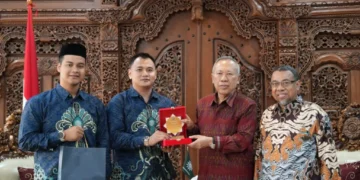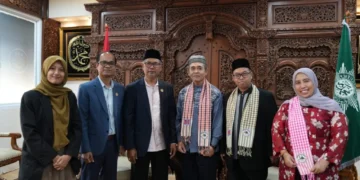


EN.MUHAMMADIYAH.OR.ID, SAMARINDA – Muhammadiyah now operates 165 Muhammadiyah-‘Aisyiyah Universities (PTMA) across Indonesia and one in Malaysia. The figure should come as little surprise, as plans to establish higher education institutions within Muhammadiyah date back to before Indonesia gained independence.

The idea was first discussed by Kiai Hisyam, Chairperson of Muhammadiyah’s School Affairs Division, during a Muhammadiyah members’ meeting on July 17, 1920, at the Muhammadiyah Central Board (Hoofdbestuur) building in Kauman, Yogyakarta.
Rather than fading, Muhammadiyah’s higher education network has continued to grow. Hundreds of its campuses are spreading across Indonesia, with another in Malaysia. Together, they stand as a lasting record of Muhammadiyah’s reformist vision, one that has endured across generations.
“Even before independence, we were already talking about higher education. If we look carefully at Yogyakarta, there is one of the oldest universities, the Indonesian Islamic University, or UII. If we look at its founders, many of them were Muhammadiyah figures,” said Ahmad Dahlan Rais, Chairperson of the Muhammadiyah Central Board, at Muhammadiyah University of East Kalimantan (UMKT) in Samarinda on Tuesday (15/9).
Beyond UII in Yogyakarta, Ahmad Dahlan Rais also noted that the establishment of an Islamic higher education institution in Central Java had involved a Muhammadiyah figure in its founding process.
Dahlan Rais added that Muhammadiyah, including its cadres and leaders, had embraced reformist ideas, or tajdid, focused on progress since the organization’s early years.
“Muhammadiyah wants to stay ahead of change, not merely walk around in front of its own house,” Dahlan Rais said.
Learning From the Past to Shape the Future
Recalling Kiai Ahmad Dahlan’s message that “Muhammadiyah today will be different from Muhammadiyah in the future,” Dahlan Rais encouraged Muhammadiyah cadres, leaders, and members to think strategically and reflectively. He said it was no longer enough to ask what something is. Muhammadiyah must also ask how and why.
The words “today” and “tomorrow” point to the importance of time. This is consistent with the history of Kiai Ahmad Dahlan, who taught Surah Al-Asr to his students for longer than he taught Surah Al-Ma’un. Al-Asr took eight months, while Al-Ma’un took only three.
“So, if we want to become Muhammadiyah members with sufficient knowledge and insight, we should return to Al-Asr without setting aside Al-Ma’un,” he said.
For that reason, Dahlan Rais expressed hope that Muhammadiyah would remain relevant as society changes with the times.
This, he said, is consistent with the organization’s own documents, which describe Muhammadiyah as a movement. As a movement, he added, stopping is not an option.