
Sunday, September 20, 2026
  • AR
  • ENG
  • IDN
Muhammadiyah Media
  • EDUCATION
  • HEALTH
  • ECONOMY
  • HUMANITY
  • OTHERS
    • RELIGION
    • LAW & POLITICS
    • IDEOLOGY
    • SOCIO-CULTURE
    • ENVIRONMENT
    • MEDIA
No Result
View All Result
  • Login
Muhammadiyah Media
  • EDUCATION
  • HEALTH
  • ECONOMY
  • HUMANITY
  • OTHERS
    • RELIGION
    • LAW & POLITICS
    • IDEOLOGY
    • SOCIO-CULTURE
    • ENVIRONMENT
    • MEDIA
No Result
View All Result
  • Login
Muhammadiyah Media
No Result
View All Result
  • EDUCATION
  • HEALTH
  • ECONOMY
  • HUMANITY
  • OTHERS
Home News

Muhammadiyah and Salafism: Similarities and Differences

by Persyarikatan Muhammadiyah
3 years ago
in News
Reading Time: 2 mins read
A A
Muhammadiyah and Salafism: Similarities and Differences

MUHAMMADIYAH.OR.ID, YOGYAKARTA—Chairman of Muhammadiyah, Agung Danarto, believed that the thoughts of Ibn Taymiyyah were one of the origins of Muhammadiyah. Born in 1263, Ibn Taymiyyah had the doctrine that ijtihad (independent reasoning) was never closed. During his lifetime, he often engaged with philosophers as Mu’tazilah, Maturidiah, and Asy’ariyah. The essence of his criticism was to reject reason in constructing the understanding of the creed. Salafis only believes in the creed shown on verses of al-Qur’an and hadiths.

“A rational mind does not have power to interpret the Qur’an, except within the limits allowed by the language and reinforced by the hadith. The power of the rational mind only affirms and obeys nash (text),” said Agung in the Ramadan Preaching 1444 H held by Muhammadiyah on Saturday (25/03).

Agung said that, according to Ibn Taymiyyah, Salafi creed relies on three aspects: the oneness of God in essence and attributes, the oneness of God in creation/rububiyah, and the oneness of God in worship/uluhiyah. The consequence of this thought is that humans must worship Allah and not recognize any other deity besides Allah. The implication is a prohibition on elevating living or dead human beings as intermediaries to Allah, sanctifying graves, prohibiting visits to graves, and others.
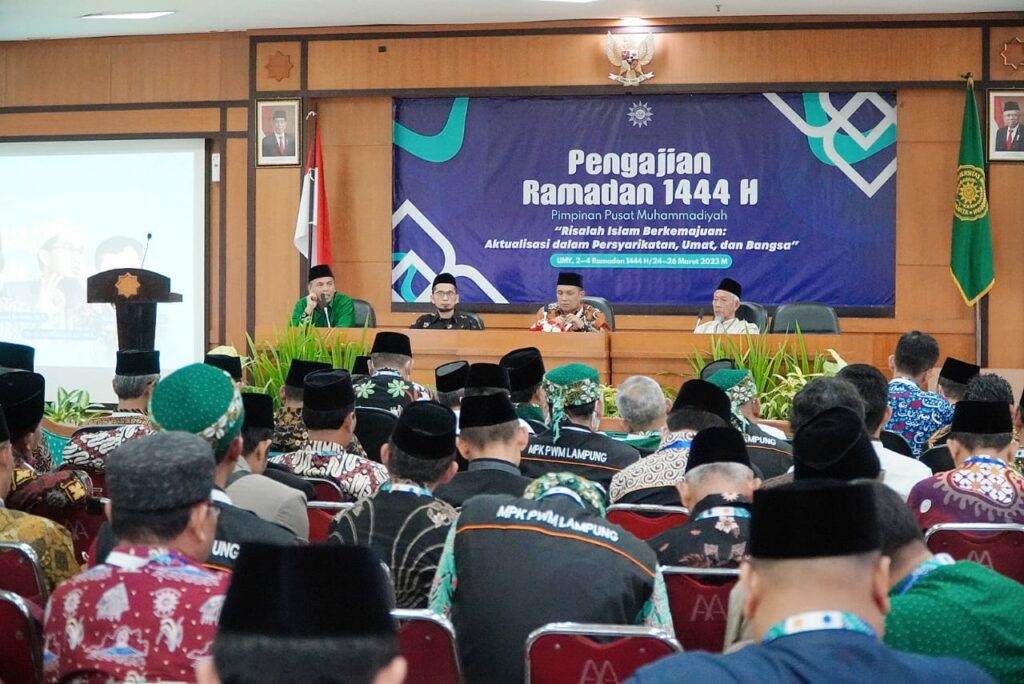
“I think Ibn Taymiyyah’s thoughts are very strong in Muhammadiyah. Indeed, for a long time, Muhammadiyah tends to prohibit visits to graves, fearing to ask for blessings. For Ibn Taymiyyah, what is prohibited is asking for blessings. If it is only as a reminder of death, I think it doesn’t matter,” said Agung.

RelatedArticle

Bullying in the Hadith: Harming Others Comes at a Cost

Muhammadiyah-‘Aisyiyah Universities Carry the Legacy of a Timeless Reformist Vision

Muhammadiyah and Global Peace Foundation Strengthen Peacebuilding Efforts

Agung continued that the successor of Ibn Taymiyyah in Salafism was Muhammad ibn Abd al-Wahab. This figure, who was from Arabia and was born in 1703, was more stringent in his religious practice than Ibn Taymiyyah. Some of his teachings are that one should not pray to Allah through intermediaries (wasilah); asking for help from a sheikh or deceased wali (saint) for getting married, having children, fortune, and safety is shirk; it is haram to recite dhikr (remembrance of Allah) and wirid (remembrance of Allah through reciting certain phrases) using a tasbih (a set of prayer beads); and it is haram to celebrate the Prophet’s birthday (maulid).

“In Muhammadiyah, some celebrate the Prophet’s birthday, while others do not. Tawasul (seeking mediation) and manaqiban (reciting praises of the Prophet) seem rare in Muhammadiyah. Some members of Muhammadiyah also participate in tahlilan (commemoration of the deceased) but do not organize it as hosts,” said Agung.

For Wahhabis, the sources of Islamic teachings are only the Quran and Sunnah, which are understood literally. Ijtihad is not a source but a method. According to Agung, this idea is different from Muhammadiyah, which understands both sources of Islamic law rationally.

ShareTweetSendShareShare
Previous Post

Progressive Islam, Muhammadiyah’s Effort to Reconstruct the Glory of Islam

Next Post

Video of Meeting between PP Muhammadiyah and Densus 88 Head

RelatedPosts

Bullying in the Hadith: Harming Others Comes at a Cost
News

Bullying in the Hadith: Harming Others Comes at a Cost

19 September 2026
Muhammadiyah-'Aisyiyah Universities Carry the Legacy of a Timeless Reformist Vision
Education

Muhammadiyah-‘Aisyiyah Universities Carry the Legacy of a Timeless Reformist Vision

19 September 2026
Muhammadiyah and Global Peace Foundation Strengthen Peacebuilding Efforts
Humanity

Muhammadiyah and Global Peace Foundation Strengthen Peacebuilding Efforts

18 September 2026
Muhammadiyah Strengthens School Management through Training Program in China
Education

Muhammadiyah Strengthens School Management through Training Program in China

18 September 2026
Next Post

Video of Meeting between PP Muhammadiyah and Densus 88 Head

Differences Between Salafism and Muhammadiyah

Differences Between Salafism and Muhammadiyah

Islamic Backwardness Occurs due to a Historical Error

Islamic Backwardness Occurs due to a Historical Error

Discussion about this post

Populer News

  • Safa and Marwa: Uncovering the Historical Depths of Two Sacred Hills

    Safa and Marwa: Uncovering the Historical Depths of Two Sacred Hills

    0 shares
    Share 0 Tweet 0
  • Muhammadiyah Appoints Crown Prince of Perlis as UMAM’s First Chancellor

    0 shares
    Share 0 Tweet 0
  • Is It Permissible for Muslims to Blow Out Birthday Candles?

    0 shares
    Share 0 Tweet 0
  • Ta’aruf in Islam: Ethical Guidelines for Getting to Know Potential Spouse

    0 shares
    Share 0 Tweet 0
  • Leader’s Profile: Dr. H. M. Busyro Muqoddas, S.H., M.Hum.

    0 shares
    Share 0 Tweet 0
  • Fatwa on Using Mirin in Cooking for Muslims in Japan

    0 shares
    Share 0 Tweet 0
  • Leader’s Profile: dr. H. Agus Taufiqurrohman, Sp.S., M.Kes.

    0 shares
    Share 0 Tweet 0
  • Leader’s Profile: M. Sayuti, M.Pd., M.Ed., Ph.D.

    0 shares
    Share 0 Tweet 0
  • Why Ramadan 1447 Hijri Falls on February 18, 2026

    0 shares
    Share 0 Tweet 0
  • Punishing Corruption in Islam: Legal, Moral, and Spiritual Dimensions

    0 shares
    Share 0 Tweet 0

Council

  • Religious Opinion & Tajdid
  • Religious Preaching
  • Higher Education, Research, & Development
  • Elementary, Secondary, & Non-Formal Education
  • Cadre & Human Resources
  • Public Health
  • Social Welfare
  • Economy, Business, & Tourism
  • Waqf Utilization
  • Community Empowerment
  • Law and Human Rights
  • Enviromental Preservation
  • Publications & Information

Institutions

  • Islamic Boarding School
  • Branch & Mosque Development
  • Strategic Studies & Partnerships
  • Financial Supervision & Development
  • Disaster Management Center
  • Charity Management
  • Micro, Small, & Medium Enterprise
  • Politics & Public Policy
  • Arts & Culture
  • Sports & Development
  • International Relations & Cooperation
  • Community Da'wah
  • Halal Auditing & "Halalan Thayyiban" Studies
  • Hajj & Umroh
  • Legal Aid & Public Advocacy

Bureau

  • Organization Development
  • Financial Management
  • Communication & Public Services

Ortom

  • 'Aisyiyah Woman Association
  • Muhammadiyah Youth Association
  • Nasyiatul 'Aisyiyah Young Woman Association
  • Muhammadiyah University Student Association
  • Muhammadiyah Student Association
  • Muhammadiyah Tapak Suci Martial Arts
  • Muhammadiyah Hizbul Wathan Scouts

Sumatra Region

  • Nanggroe Aceh Darussalam
  • Sumatra Utara
  • Sumatra Selatan
  • Sumatra Barat
  • Bengkulu
  • Riau
  • Kepulauan Riau
  • Jambi
  • Bangka Belitung

Kalimantan Region

  • Kalimantan Barat
  • Kalimantan Timur
  • Kalimantan Selatan
  • Kalimantan Tengah
  • Kalimantan Utara

Jawa Region

  • D.I. Yogyakarta
  • Banten
  • DKI Jakarta
  • Jawa Barat
  • Jawa Tengah
  • Jawa Timur

Bali & Kepulauan Nusa Tenggara

Region

  • Bali
  • Nusa Tenggara Barat
  • Nusa Tenggara Timur

Sulawesi Region

  • Gorontalo
  • Sulawesi Barat
  • Sulawesi Tengah
  • Sulawesi Utara
  • Sulawesi Tenggara
  • Sulawesi Selatan

Maluku dan Papua Region

  • Maluku Utara
  • Maluku
  • Papua
  • Papua Barat
  • Papua Barat daya

Special Branch

  • Kairo Mesir
  • Iran
  • Sudan
  • Belanda
  • Jerman
  • United Kingdom
  • Libya
  • Malaysia
  • Prancis
  • Amerika Serikat
  • Jepang
  • Tunisia
  • Pakistan
  • Australia
  • Rusia
  • Taiwan
  • Tunisia
  • TurkI
  • Korea Selatan
  • Tiongkok
  • Arab Saudi
  • India
  • Maroko
  • Yordania
  • Yaman
  • Spanyol
  • Hongaria
  • Thailand
  • Kuwait
  • New Zealand

Category

  • Education
  • Health
  • Economy
  • Humanity
  • Religion
  • Law & Politics
  • Ideology
  • Culture
  • Media

About

  • History
  • Brand Guideline

Services

  • Information

Apps

  • Muhammadiyah ID
  • MASA
  • EventMu
  • BukuMu
  • SehatMu
  • KaderMu
  • LabMu

More Information

  • Editorial
  • Contact
  • Privacy Policy
© 2024 Persyarikatan Muhammadiyah

Welcome Back!

Login to your account below

Forgotten Password?

Retrieve your password

Please enter your username or email address to reset your password.

Log In

Add New Playlist

No Result
View All Result
  • icon bendera arab
  • bendera indonesia
  • EDUCATION
  • HEALTH
  • ECONOMY
  • HUMANITY
  • OTHERS
    • RELIGION
    • LAW & POLITICS
    • IDEOLOGY
    • SOCIO-CULTURE
    • ENVIRONMENT
    • MEDIA
  • Login

© 2024 Persyarikatan Muhammadiyah - Cahaya Islam Berkemajuan.