

EN.MUHAMMADIYAH.OR.ID, YOGYAKARTA – The launch of a book titled Ascetic Jurists in the Age of the Death of Expertise, a book commemorating the 70th birthday of Prof. Syamsul Anwar, reflects Muhammadiyah’s tradition of honoring distinguished Islamic scholars rather than engaging in personality cults.

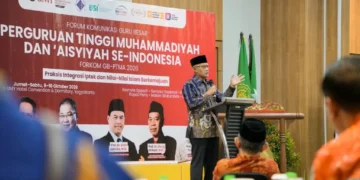
Muhammadiyah President Haedar Nashir made the remarks on Monday (31/8) at the Dormitory of Muhammadiyah University of Yogyakarta.
According to Haedar, Muhammadiyah does not need to borrow the concept of takzim, or reverence, from outside traditions. The organization has long taught the importance of honoring people, particularly those with deep knowledge and scholarship.
“We need to revive that tradition. We are fortunate to have an egalitarian tradition, a democratic tradition, and a tradition of openness in Muhammadiyah, all rooted in equality. But alongside that, we also need to cultivate an attitude of takzim,” he said.
Haedar said that both egalitarianism and reverence for learned scholars have, in substance, long existed within Muhammadiyah. He stressed that the two traditions should be preserved and strengthened.
Syamsul Anwar as One of Ar-Rasikhuna fi Al-’ilm
Discussing the launched book, Haedar said it was entirely consistent with Syamsul Anwar’s character.
In Haedar’s view, Prof Syamsul is a Muslim intellectual who has reached the level of ar-rasikhuna fi al-’ilm, those whose knowledge is deep, firmly grounded, and well established.
“Such people are rare. We need to continue developing our cadres, including those in the Council for Religious Opinion and Reform, so they become deeply learned, advance to the level of ulul albab, and ultimately reach the higher level of ar-rasikhuna fi al-’ilm,” Haedar said.
Looking ahead, he said Muhammadiyah needs scholars who are both faqih, or deeply knowledgeable in Islamic jurisprudence, and multidimensional in their outlook. They must be able to approach dirasah Islamiyah, or Islamic studies, through an integrated and interconnected perspective (perspectivism).
“We have received solutions to many complex issues through Prof. Syamsul, both during his time at the Tarjih Council and at the Muhammadiyah Central Board. Institutionally, such matters fall within the authority of Tarjih. But when the Central Board needs clarification and certainty in making policy decisions, Prof. Syamsul is the person we turn to,” he said.
Haedar cited two particularly challenging moments in which solutions were found “thanks to Prof. Syamsul”: the Covid-19 pandemic and Muhammadiyah’s official adoption of the Unified Global Hijri Calendar (KHGT).