

EN.MUHAMMADIYAH.OR.ID, BANTUL – To grow within Muhammadiyah takes one step at a time. Members should first learn, grow, and embrace the process. Muhammadiyah Leadership is developing naturally.

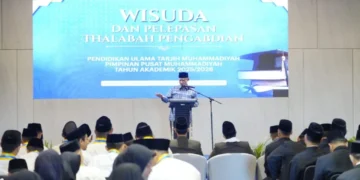
Haedar Nashir, President of Muhammadiyah, conveyed the message on Saturday (29/8) during the Graduation and Farewell Ceremony of Muhammadiyah Ulama Higher Education at Muhammadiyah University of Yogyakarta.
Being a leader in Muhammadiyah, said Haedar, is a natural process, without coercion. This, he said, has helped ensure that leadership transitions within the organization proceed smoothly and maturely.
“People do not initially aspire to positions of leadership. But once that desire grows, is encouraged, and someone feels capable, that is where the struggle for positions begins. Knowledge, confidence, and ability are all shaped through a process of struggle,” he said.
Messages for Branches and Subbranches Cadres
Haedar also encouraged Muhammadiyah cadres not to fear being assigned to branches or subbranches boards, including those overseas. Cadres, he said, must be ready to contribute wherever they are placed because Muhammadiyah does not exist only at the central level.
“Muhammadiyah is great because it has also been built by those in the grassroots units, congregations, branches, and the most remote areas. Their work may be limited, but their sincere prayers reach the heavens,” he added.
He further emphasized that Muhammadiyah leaders at every level must adhere to the organization’s system. A leader who acts solely according to personal will, he said, has effectively departed from Muhammadiyah’s principles.
“We must have ideological principles that guide us, especially when we become leaders,” Haedar stressed.
According to him, this organizational system is one of Muhammadiyah’s greatest strengths. It does not exist only at the central level but extends throughout the organization, from grassroots units and branches to regional and provincial leadership.
However, the system does not make Muhammadiyah a rigid organization. Haedar said new ideas, whether related to religion, social issues, economics, or other fields, can always be brought into deliberative forums.