

MUHAMMADIYAH.OR.ID, YOGYAKARTA – Even before scholars formally theorized it, Muhammadiyah had already embraced what can be described as a relational-functional concept of tauhid (monotheism). Observers can trace this tendency through the organization’s social history and reform movements.

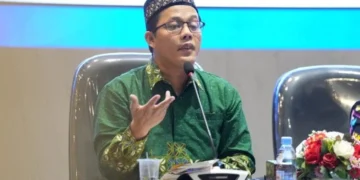
Ustadi Hamzah, a member of Muhammadiyah Council for Religious Opinion and Reform, delivered that assessment on Saturday (21/2) during the Ramadan Sermon series at Muhammadiyah University of Yogyakarta (UMY).
From Theocentrism to Cosmocentrism
According to Ustadi, contemporary Islamic theology should move beyond classical theocentrism and even beyond anthropocentrism. Instead, it must enter a cosmocentric phase. In fact, he noted, some current discussions already frame tauhid within a biocentric perspective that emphasizes responsibility toward all living beings.
Therefore, debates over Sunni and Shia theological dichotomy have gradually lost urgency in the contemporary period. “Perhaps the older generation still asks whether someone is Sunni or Shia,” he said. “But among younger Muslims, many simply say, ‘we are Muslim,’ and leave it at that.”
At the same time, he stressed that Muslims should not discard the historical legacy of theological schools (firqah). Rather, they should preserve that heritage as part of Islam’s intellectual wealth.
Three Orientations of Functional Tauhid
Ustadi proposed that scholars draw from classical theological traditions to build a typology of thought oriented toward three key goals.
First, Muslims must interpret tawhid as a value system rather than as an identity marker of sectarian affiliation. Believers should not trap themselves within rigid school-based categories. Instead, tawhid must elevate human dignity. “Tawhid should become a value that ennobles our humanity,” he explained, “not a concept that reduces us because we imagine ourselves as rivals to God.”
Second, tawhid must address humanity, justice, universality, and progress. Consequently, Muslim thought should actively promote these principles. Otherwise, discussions of monotheism risk reverting to classical polemics detached from real-world concerns. He argued that tawhid must function as a framework that uplifts and dignifies human life.
Third, Muslims should direct tawhid toward concrete solutions. It cannot remain confined to abstract discourse or endless debate. Instead, it must inspire problem-solving and practical engagement with contemporary challenges.
In short, Ustadi concluded, the future of Islamic theology lies not in sectarian argumentation but in a functional monotheism that advances justice, humanity, and civilizational progress.
Translator: Bintang Adrian