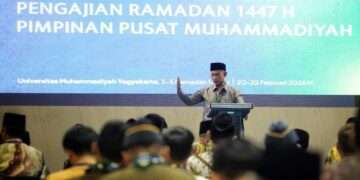


MUHAMMADIYAH.OR.ID, YOGYAKARTA — The idea of reconstructing the understanding of Islamic creed (aqidah) drew attention during a Ramadan Sermon session organized by Muhammadiyah Central Board at Muhammadiyah University of Yogyakarta (UMY) on Saturday (21/2).

During the discussion, a participant questioned how long theological interpretations can remain relevant amid rapid social transformation. He raised concerns that if interpretations continue to shift with the times, they may quickly lose relevance and create confusion in society.
“Won’t interpretations also change very quickly?” he asked. “How can we construct an interpretation that lasts long enough and remains relevant?”
Interpretation and Context
Responding to the question, noted Muslim scholar Amin Abdullah admitted that the lifespan of interpretation is never simple to determine. Islamic intellectual history, he explained, shows that interpretations sometimes change within a single lifetime, while others endure for centuries.
He pointed to the experience of Al-Shafi‘i, who formulated two phases of legal reasoning—qawl qadim (the old opinion) and qawl jadid (the new opinion)—after moving from Baghdad to Egypt. The shift in social and intellectual context led him to revise his views.
“This change happened during his own lifetime,” Amin said, emphasizing that context strongly shapes interpretation.
According to him, some interpretations survive only for a generation, while others last for centuries before eventually becoming stagnant. Longevity alone, therefore, does not guarantee vitality.
Toward a Dynamic Methodology
Amin argued that Muhammadiyah, as a reform (tajdid) movement, must dare to formulate new methodological frameworks to guide renewal responsibly. With its broad educational network and intellectual tradition, Muhammadiyah should rethink and develop a more contextual approach to usul fiqh (principles of Islamic jurisprudence).
He proposed a dynamic epistemological principle: what people consider definitive (qat‘i) may in fact become interpretative (zanni) when viewed as a product of human understanding. Conversely, ideas once considered speculative or secondary may later become fundamental as knowledge and human experience expand.
“Kullu qaṭ‘iyyatin ẓanniyyatun biḥasabi nuẓum al-ma‘rifah,” he said, explaining that what appears absolute can become relative at the level of interpretation. At the same time, “kullu ẓanniyyatin” may one day become qaṭ‘i, depending on scientific development and lived experience.
Lessons from Environmental Awareness
To illustrate his point, Amin referred to shifting attitudes toward environmental issues. In the past, many regarded environmental protection as a marginal concern. Today, however, global movements such as Greenpeace have elevated ecological responsibility into a central global agenda.
He also cited Indonesia’s experiences with floods, deforestation and other disasters, which have transformed public awareness about sustainability. Issues once treated as secondary now shape national survival.
“What used to be seen as speculative can become definitive,” he stressed, warning that ignoring such shifts could have serious consequences.
Openness as the Key to Relevance
Ultimately, Amin maintained that the durability of interpretation depends not on how long an opinion survives, but on the openness and breadth of intellectual engagement behind it. Limited reading and narrow perspectives, he warned, often lead to stagnation.
“If you only read one book and rely on a single perspective, that mindset can remain frozen for centuries,” he remarked.
At the same time, he cautioned that intellectual renewal should avoid confrontational language. Reform requires wise communication so that society can accept change without feeling attacked.
In conclusion, Amin emphasized that reinterpretation is not a threat to faith but part of its intellectual vitality. The true key to maintaining relevance, he said, lies in cultivating a dynamic and open way of thinking rather than merely preserving old formulations.
Translator: Bintang Adrian