

MUHAMMADIYAH.OR.ID, YOGYAKARTA – The spirit of renewal within Muhammadiyah connects to a long historical chain of islamic thought. This lineage stretches bage to the era of the Khulafaur Rasyidin and continues through influential scholars like Ibn Taymiyyah (1263-1328), Muhammad bin Abdul Wahab (1701-1793), and Muhammad Abduh (1849-1905).

However, Haedar Nashir, the President of Muhammadiyah, argues that the organization maintains a distinct identity. While it shares roots with these figures, Muhammadiyah’s specific approach to progress sets it apart from other global Islamic movements.
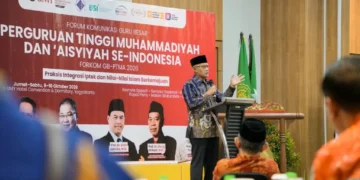
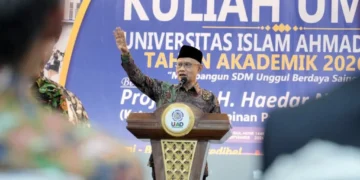
During a keynote speech at Muhammadiyah University of Yogyakarta on Friday (20/2), Haedar traced these genealogical tracks. He explained that the movement’s primary inspiration remains the Quran and the Sunnah. This foundational reference point aligns Muhammadiyah with other reformist groups seeking to return to core Islamic principles. For instance, the organization shares a clear intellectual intersection with Ibn Taymiyyah. His reformist style emerged as a direct response to the socio-political decay of his era.
Following the fall of Baghdad, Islamic traditions suffered under Mongol influence. Many practitioners began embracing mythological beliefs rather than scriptural truths. Furthermore, the veneration of influential figures’ graves became a widespread deviation. To combat these issues, Ibn Taymiyyah authored Kitabul Iman to purify the faith. This work aimed to restore the original Salafi spirit of early Islam. Consequently, his writings laid the groundwork for centuries of future theological debate.
From Ancient Texts to Modern Mobilization
Centuries later, Ibn Taymiyyah’s work inspired Muhammad bin Abdul Wahab to write Kitabut Tauhid. This text remains a primary reference for Salafi groups across Indonesia, India, and Pakistan today. Nevertheless, Abdul Wahab’s movement differed slightly from his predecessor’s vision. His specific focus reacted to the local rise of polytheism and spiritual deviations in the 19th century. These historical shifts illustrate how reform constantly adapts to its immediate environment.
Muhammadiyah also draws significant inspiration from the Egyptian reformer Muhammad Abduh. His writings resonated deeply with Kiai Ahmad Dahlan, the founder of Muhammadiyah. Specifically, the magazine Urwatul Wustha played a pivotal role in spreading these ideas globally. This publication, co-founded with Jamaluddin Afghani in 1884, called for liberation from Western imperialism. Because the Islamic world felt trapped by colonial powers, the magazine’s message ignited a fire of renewal across the globe.
Haedar Nashir insists that we must not view these historical figures through a pejorative lens. Labeling them dismissively diminishes their massive contribution to Islamic thought. However, he also emphasizes that Muhammadiyah is not a carbon copy of its predecessors. While the organization values its intellectual ancestors, it introduced radical innovations that were previously unseen in the Muslim world. These distinctions define the movement’s modern legacy.
Building a Distinct Identity Through Action
The most striking difference lies in Muhammadiyah’s commitment to women’s rights. Nashir noted that most previous movements discussed women only in theoretical terms. In contrast, Muhammadiyah established ‘Aisyiyah as a formal movement for progressive Muslim women. This move transformed abstract ideas into a tangible social force. Therefore, the organization empowered women to take active roles in public life and education.
Beyond gender equality, the creation of Amal Usaha Muhammadiyah (AUM) marks another major departure. This network of schools and hospitals stems from the “Al-Ma’un” ethos of serving the poor. No prior reformist movement had successfully translated theology into such an extensive system of social services. Thus, Muhammadiyah combined spiritual purification with practical, humanitarian action. This unique blend of tradition and modernity continues to define its role in the 21st century.