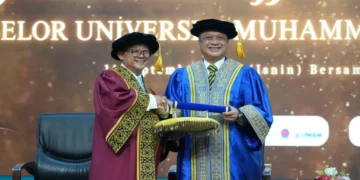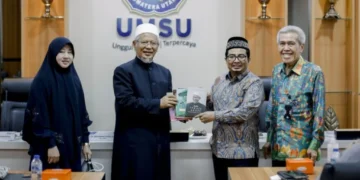


MUHAMMADIYAH.OR.ID, YOGYAKARTA—Ahmad Najib Burhani, Director General of Science and Technology at the Ministry of Higher Education, Science, and Technology, delivered thought-provoking insights on how society responds to the rise of artificial intelligence (AI).

He shared these views during the SiberMu National Seminar on Business, Technology, and Health (SINABTECH) 2025, held on Thursday (16/10) at the SMTORIUM Ballroom, SM Tower Malioboro, Yogyakarta.
As the Vice Chairperson of Muhammadiyah’s Council for Publication and Information, Najib emphasized that societal responses to AI are not monolithic. Instead, they can be divided into several major groups, each reflecting a distinct worldview toward the significant changes underway.
He explained that there are AI pessimists, those who view AI negatively and fear it could replace human roles or even pose a threat to civilization.
Meanwhile, skeptical adopters take a more cautious stance toward optimistic claims about AI. They adopt the technology in a measured and vigilant way.
On the other hand, there are pragmatic users who pay little attention to philosophical or ethical debates surrounding AI. For them, AI is simply a tool to enhance productivity and daily efficiency.
Finally, there are AI enthusiasts, those who view AI with excitement and see it as a tremendous opportunity to transform the world for the better. They believe AI will drive innovation and human progress.
Najib noted that these four response models are adapted from The Future of Writing Instruction: Navigating AI’s Impact by Becah Bussele and Patrick Moyle. Understanding the diversity of perspectives is crucial, he said, because it will shape education policy and the development of transformative learning in Indonesia.
Najib then linked the Ai phenomenon to the concept of “transformative learning” developed by modern education theorists Jack Mezirow. This concept involves ten stages of transformation, one of which is the disorienting dilemma: a disruptive experience that challenges a person’s old worldview.
“A disorienting dilemma can be a life-changing event such as a divorce, encountering minority communities, or meeting someone of a different faith. These experiences push us to think critically and reassess long-held assumptions,” he explained.
In the context of modern education, Najib argued, AI represents a new form of disorienting dilemma. This technology forces us to reconsider long-standing concepts: what it means to be a writer when machines can produce books; what it means to be a scholar in an AI-assisted world, and; how to understand plagiarism when machines can paraphrase without leaving traces of the original source.
“AI compels us to redefine the meaning of creativity, reflection, and critical thinking. In the past, creative people were those who could create something from scratch. Today, they might be those who are most skilled at crafting prompts to mine AI’s vast data resources,” he said.
According to Najib, this paradigm shift inspired the development of the book Transformative Learning in Higher Education Based on AI, which he described as an effort to respond to the technological revolution through a sound and ethical academic framework.
“AI doesn’t just change how we work and learn, it also transforms the very meaning of education itself,” he concluded. (Bintang Adrian)