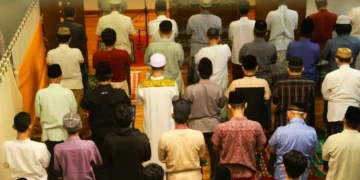


EN.MUHAMMADIYAH.OR.ID, YOGYAKARTA — Homaidi Hamid, a member of the Council for Religious Opinion and Reform of Muhammadiyah, addressed a range of contemporary questions surrounding qurban during a religious lecture in Yogyakarta on Wednesday (20/5).

Speaking at a Muhammadiyah study session titled Issues Surrounding Qurban, Homaidi explained that animal sacrifice has existed since the earliest period of human history. He referred to the Qur’anic story of Abel and Cain in Surah Al-Ma’idah, where both brothers presented sacrifices to God.
According to him, the narrative demonstrates that the essence of qurban lies not merely in slaughtering animals, but in cultivating sincerity and piety.
“The central value of qurban is devotion to God,” he said during the lecture.
Homaidi explained that the Arabic term udhiyah refers to livestock slaughtered during Eid al-Adha and the following days of tashriq as an act of worship. Meanwhile, the term mudhahhi refers to the individual offering the sacrifice.
In addition, he outlined several spiritual lessons associated with qurban. Among them are following the example of the Prophet Ibrahim, strengthening obedience to God, expressing gratitude, and seeking forgiveness for sins.
On the legal status of qurban, Homaidi noted that Islamic scholars hold differing opinions. Some scholars, including Abu Hanifah and Ibn Taymiyyah, considered qurban obligatory for financially capable Muslims. However, the majority of scholars classify it as sunnah muakkadah, a highly emphasized religious practice.
“Muhammadiyah adopts the second opinion,” Homaidi said.
He also clarified that one goat is sufficient for an entire household, a position widely accepted in Islamic jurisprudence.
Clarifying Questions About Shared Sacrifice and Family Obligations
During the session, Homaidi responded to several practical concerns often raised by Muslim communities ahead of Eid al-Adha.
One recurring question involved Muslims who wish to perform qurban despite never having undergone aqiqah, the sacrifice traditionally offered after childbirth. Homaidi said the absence of aqiqah does not invalidate qurban because both practices serve different religious purposes.
“Aqiqah has its own prescribed time during infancy,” he explained. “Qurban is a separate act of worship connected to Eid al-Adha.”
Furthermore, he emphasized that no Islamic text requires aqiqah to precede qurban.
Homaidi also addressed concerns about delegating the slaughtering process. According to him, qurban remains valid even if another person performs the slaughter, provided the original intention belongs to the owner of the animal.
Therefore, Muslims may appoint committee members or professional butchers to handle the sacrifice.
Another issue discussed involved collective qurban contributions. Homaidi stressed that one cow or buffalo may represent no more than seven people under Islamic law. If additional names are included, he said, the arrangement no longer qualifies as formal qurban but instead becomes a form of collective charity.
“The practice remains good as long as its status is explained honestly,” he said.
Because of that, he encouraged mosque committees to separate qurban funds clearly from general donations in order to avoid confusion.
He also approved rotating savings systems, commonly known in Indonesia as arisan qurban, as long as participants act transparently and avoid usury. In his view, such systems can help Muslims plan for worship without creating financial pressure.
Trust and Transparency Remain Central Principles
Homaidi further explained that a goat offered by one individual may still include intentions of blessing and reward for the entire family. Even so, he stressed that the official shahibul qurban, or owner of the sacrifice, remains a single person.
He later warned organizers against listing more than seven names under one cow or buffalo while still presenting it as qurban. If communities wish to involve more contributors, he suggested creating separate charitable donation schemes instead.
The lecture also covered questions about offering qurban on behalf of deceased relatives. Homaidi stated that if the deceased had explicitly vowed or requested qurban before death, the family must fulfill it using the person’s estate.
However, families hold no obligation if the deceased merely intended to perform qurban without making a formal vow.
When discussing meat distribution, Homaidi referred to Surah Al-Hajj Verse 36, which encourages Muslims to eat part of the meat and distribute the rest to those in need. He added that Islamic teachings allow Muslims to consume, store, or donate the meat without requiring a strict one-third division formula.
Toward the end of the lecture, Homaidi addressed the controversial issue of redirecting qurban funds toward mosque construction or other projects.
According to him, donors may voluntarily change their intention before the sacrifice takes place if they believe another social need deserves greater priority. Nevertheless, he stressed that organizers cannot redirect animals or funds without the owner’s permission.
“The essence of the issue is trust,” he said.
He delivered a similar warning regarding the use of qurban animals for wedding celebrations or other private events. If committee members misuse donated animals without approval, he argued, they must replace them with equivalent livestock and distribute the sacrifice properly.