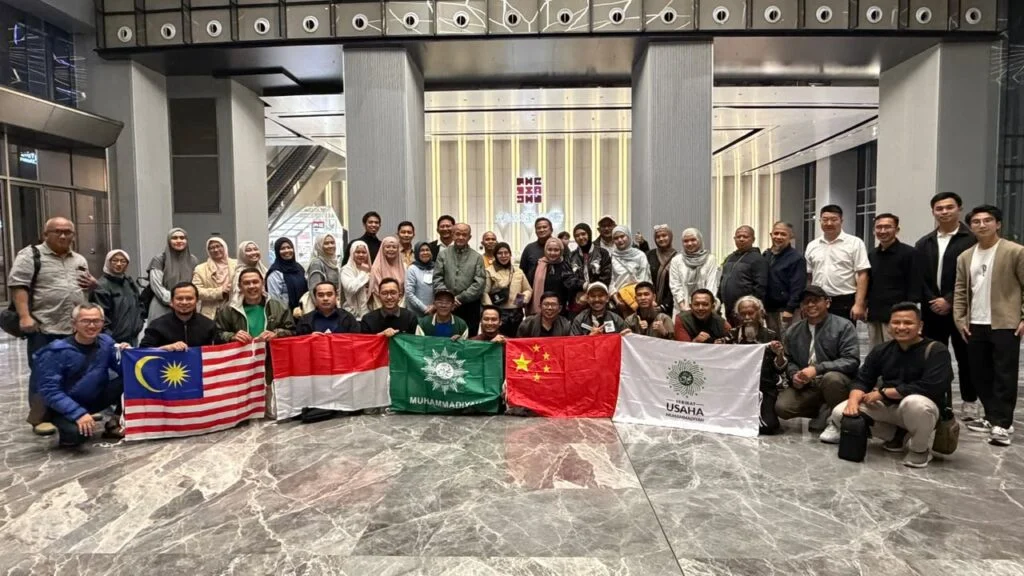
EN.MUHAMMADIYAH.OR.ID, YIWU – Anwar Abbas, a Chairperson of the Central Board of Muhammadiyah, has highlighted the potential of Yiwu International Trade City in China’s Zhejiang Province as a global wholesale trading hub that could serve as a model for developing businesses and strengthening the competitiveness of Muhammadiyah entrepreneurs.

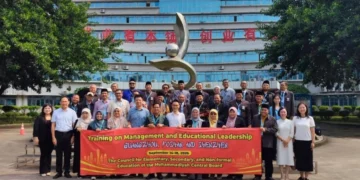
He shared these observations while accompanying around 50 members of the Muhammadiyah Business Association (SUMU) on their visit to Yiwu, which began on Wednesday (21/10). Located in eastern China, the city is known as one of the world’s largest wholesale trading centers.
According to Anwar, Yiwu’s relative proximity to major cities such as Hangzhou, Shanghai, and Ningbo has helped support its growth as an international trade hub.
“One of Yiwu’s main attractions is the International Trade City, also known as Yiwu Market,” he said.
The trading complex, covers approximately 6.4 million square meters, is divided into five major districts, and houses more than 75,000 supplier booths offering a wide range of products.
An Integrated Trade and Industrial Ecosystem
Anwar explained that Yiwu’s strength lies not only in the scale of its market but also in its integrated trade and industrial ecosystem. Manufacturers, suppliers, and distributors operate within the same area, allowing buyers to transact directly with producers without relying on multiple intermediaries.
This arrangement helps streamline supply chains and makes product prices more competitive. For business owners, particularly micro, small, and medium-sized enterprises (MSMEs), such an ecosystem offers opportunities to source goods at more affordable prices.
Yiwu also makes purchasing more accessible through relatively low minimum order quantities (MOQs) for certain products.
“This arrangement creates opportunities for entrepreneurs with limited capital to begin trading and expand their business networks,” he said.
From a distribution perspective, Yiwu benefits from access to the seaports of Ningbo and Shanghai, as well as international freight rail connections linking China with several countries in Central Asia and Europe. This infrastructure supports the distribution of goods to international markets, including Indonesia.
Lessons for Muhammadiyah Entrepreneurs
For Anwar, studying Yiwu’s trade ecosystem offers valuable lessons for Muhammadiyah entrepreneurs seeking to build business networks, improve distribution efficiency, and gain greater access to global markets.
The SUMU delegation’s visit also provides an opportunity for business owners to observe firsthand how the integration of suppliers, manufacturers, logistics infrastructure, and trade access can support economic growth.
Anwar also posed a reflective question about whether Indonesia could develop a trading hub with an integrated ecosystem similar to Yiwu.
“The question is, when will Indonesia have a city like Yiwu? I do not know the answer,” he said.
His remarks serve as a reminder that developing a global-scale trading hub requires a strong business ecosystem, efficient supply chains, supportive infrastructure, and close connections between producers and markets.