

EN.MUHAMMADIYAH.OR.ID, YOGYAKARTA – Controversial Video Assistant Referee (VAR) decisions in football should not be viewed merely as questions of right or wrong under the Laws of the Game. Behind every ruling, there are deeper issues of trust, suspicion, and the pursuit of justice that reveals how people interpret events.

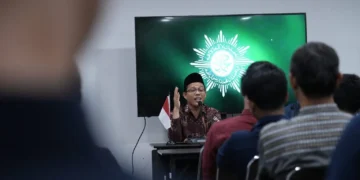
The view was delivered by Mohammad Syifa Amin Widigdo, a member of the Muhammadiyah Central Board’s Religious Opinion and Reform Council. He delivered his notion during a podcast published on the Wonderhome Library channel on Thursday (9/7).
Syifa observed that football matches are often decided not only by the players’ performances but also by refereeing decisions. A single whistle or VAR review can alter the outcome of a game while igniting widespread public debate.
He pointed to the controversial match between Argentina and Egypt as an example. Egypt had a goal disallowed after VAR identified a foul on Lisandro Martínez during the attacking sequence. At the other end, Egyptian players argued that Mohamed Salah had been fouled inside the penalty area, yet the referee declined to award a penalty. The decisions ultimately helped Argentina secure victory, while Egypt believed it had been unfairly treated.
According to Syifa, the referee’s decisions were procedurally supported by the Laws of the Game. VAR intervention is limited to four match-changing situations: goals, penalty decisions, straight red cards, and cases of mistaken identity. Moreover, an on-field decision may only be overturned when a “clear and obvious” error has occurred.
Nevertheless, he stressed that VAR is not a machine that produces absolute truth. The technology still depends on camera angles, human judgment, and the referee’s interpretation of physical contact. Football, therefore, is never solely about regulations; it is also shaped by emotions that influence how the public interprets officiating decisions.
Faith and Suspicion in Reading Football
To explain this phenomenon, Syifa drew on the philosophy of French thinker Paul Ricoeur, particularly his concepts of the hermeneutics of faith and the hermeneutics of suspicion.
The first approach, he explained, begins with trust. In football, those who adopt this perspective assume that referees and VAR officials have followed the proper procedures. As long as decisions are grounded in the rules, they deserve respect.
Syifa cited ESPN analysts who regarded VAR’s intervention in disallowing Egypt’s goal as correct. A similar assessment came from The Guardian journalist Scott Murray, who argued that the foul on Lisandro Martínez warranted a free kick, making the disallowed goal the appropriate outcome. Argentina head coach Lionel Scaloni likewise attributed his team’s victory to its winning mentality rather than to officiating.
By contrast, the hermeneutics of suspicion approaches refereeing decisions with greater skepticism. Rather than asking only whether the rules were correctly applied, it also questions whether those rules were enforced fairly and consistently for both sides.
Syifa noted that Egypt coach Hossam Hassan openly claimed his team had been treated unfairly. Mustafa Zico even suggested the tournament appeared to favor Argentina. Former Manchester United defender Gary Neville questioned whether an identical goal would have been disallowed had Argentina scored it. Similar concerns about VAR consistency were expressed by Roy Keane, Mark Halsey, and former Spanish referee Eduardo Iturralde.
According to Syifa, such suspicion does not emerge in a vacuum. Modern football involves commercial interests, television ratings, and powerful narratives surrounding global stars such as Lionel Messi. Consequently, when controversial decisions benefit major teams, some observers quickly suspect institutional bias.
At the same time, Syifa emphasized that suspicion should never be confused with evidence. Allegations of conspiracy cannot be justified solely by dissatisfaction with a match result.
Beyond the Final Score
Syifa argued that similar debates have also emerged in the match between Paraguay and France. Many questioned why Paraguay’s physical style of play resulted in few bookings. The controversy, he said, was ultimately about the consistent application of the rules rather than isolated fouls or yellow cards.
From these disputes, Syifa identified three broader lessons.
First, public engagement with football has grown significantly. Thanks to replay technology and social media, virtually every viewer now analyzes matches and offers independent judgments.
Second, the competitive balance in international football has become increasingly even. Nations once considered underdogs are now capable of challenging traditional powers. Argentina struggled against Egypt, France faced strong resistance from Paraguay, and several established contenders, including Germany, have already exited the tournament.
Third, public demand for fairness has intensified. Fans, Syifa observed, can usually accept defeat, but they struggle to accept the perception that identical rules are applied differently to different teams.
He therefore offered several recommendations. Referees, he said, should pursue not only procedural correctness but also consistent decision-making that inspires equal confidence from both sides. Supporters should remain critical without falling into unfounded conspiracy theories, since constructive criticism strengthens the game while baseless accusations undermine rational public discourse. FIFA, meanwhile, should communicate VAR decisions more transparently by explaining why certain incidents undergo review while others do not.
Concluding the discussion, Syifa quoted French philosopher Albert Camus, who once remarked that nearly everything he had learned about morality and obligation came from football. For Syifa, debates over VAR, penalties, red cards, and disallowed goals are ultimately debates about the ethics of the game.
“In the end, what is truly at stake is not merely the final score, but our confidence that football remains a fair game, an enjoyable spectacle, and a meaningful lesson in humanity,” he concluded.