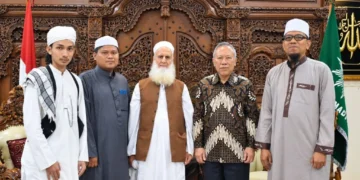


MUHAMMADIYAH.OR.ID, YOGYAKARTA — On Monday night (22/09), the atmosphere on the top floor of SM Tower Malioboro Muhammadiyah felt unique. After a warm dinner, the editorial team of Muhammadiyah.or.id had a rare opportunity to interview two important figures who have long been interested in Muhammadiyah.

The primary one was Prof. Dr. Haedar Nashir, Chairperson of Central Board of Muhammadiyah. The latter was an anthropologist from Japan who has been researching Indonesian Islam, especially Muhammadiyah, for over half a century—Prof. Mitsuo Nakamura.
Nakamura’s presence in Indonesia this time is also to introduce his latest book, entitled Observing Islam in Indonesia 1971–2023. This makes the moment is so exceptional.
On the one hand, Haedar represents the current generation of Muhammadiyah leaders, continuing the struggle of the largest modernist Islamic movement in Indonesia. Conversely, Nakamura is a witness to the long journey of Muhammadiyah from the perspective of a foreign scientist who understands Muhammadiyah “from within”.
The conversation after dinner was like a cross-national, cross-generational dialogue, about how Muhammadiyah is interpreted and where it is headed.
Haedar: A Living Inspiration from Nakamura
When asked about Mitsuo Nakamura, Haedar did not hesitate to call him one of Muhammadiyah’s sources of inspiration.
“Prof. Nakamura has been an inspiration for Muhammadiyah’s big family,” Haedar said, recalling Nakamura’s legendary research in Kotagede, Yogyakarta—an anthropological work portraying Muhammadiyah not simply as an organization, but as a social force rooted in the Islamic reform values.
That research was originally Nakamura’s doctoral dissertation at Cornell University, which later became his magnum opus, The Crescent Arises Over the Banyan Tree: A Study of the Muhammadiyah Movement in a Central Javanese Town (first edition in 1983, expanded second edition in 2012).
It was later translated into Indonesian and published by Gadjah Mada University Press under the title Bulan Sabit Muncul dari Balik Pohon Beringin: Studi tentang Pergerakan Muhammadiyah di Kotagede, Yogyakarta (1983).
According to Haedar, Nakamura’s study serves as a reminder of Muhammadiyah’s social capital. In its early years, Muhammadiyah was supported by generous merchants who provided the economic foundation for its da’wah.
Today, that social capital has evolved into institutionalized charitable enterprises: schools, hospitals, and universities.
“In the past, Muhammadiyah thrived thanks to its merchants. Today, it grows rapidly for its institutional enterprises, enabling it to finance itself as the largest Islamic organization in Indonesia, with significant assets dedicated to da’wah and humanitarian work,” Haedar explained.
Still, Haedar cautioned that Muhammadiyah must not lose its roots. The spirit of generosity from the early merchants must remain alive. Therefore, during his leadership, he sought to expand Muhammadiyah’s entrepreneurial networks to continuously grow the entrepreneurship ethos among the cadres.
“This creates synergy between personal strength and institutional strength—both serving as religious social capital to be mobilized for Muhammadiyah’s movement,” he added.
Furthermore, Haedar emphasized what he called Nakamura’s “intellectual inspiration”: the spirit of research.
“Research-based intellectualism must continue to be cultivated. As a reformist movement, Muhammadiyah cannot stop at rhetoric. We need data and social facts to further be developed into theories, paradigms, and direction of the movement,” he said.
Not only is Nakamura’s research spirit exemplary, but his perspective on Muhammadiyah also leaves a profound impression. Unlike many other Indonesianists, he sought to understand Muhammadiyah from within, as it was lived by its members.
“Prof. Nakamura uses an emic approach. He sees Muhammadiyah from the inside, not as an outsider. That allowed him to grasp its dynamics without excessive judgment,” Haedar said.
Such humility, he added, is invaluable. “Criticism is necessary, but it must be delivered properly. From him, we learned that,” he noted.
Haedar also highlighted that despite Nakamura’s age—92—, his intellectual spirit remains undimmed. “That’s a tremendous inspiration for Muhammadiyah’s cadres,” he stressed.
For Haedar, that evening’s meeting was not just an interview, but also a moment of nostalgia. He recalled that in 1984, when he was a young journalist, he interviewed Nakamura at the Central Board (PP) of Muhammadiyah’s office.
Now, forty years later, they met again. “It’s a memory that continues to this day,” he said with a smile.
Nakamura: From Kotagede to Understanding Islam
Prof. Nakamura opened his story candidly. He admitted that he initially had no intention of researching Islam, let alone Muhammadiyah.
“I came to Kotagede solely to research social history. That was my initial proposal,” he recalled.
However, the reality changed everything. Kotagede was closely tied to Islamic values, particularly those of Muhammadiyah. It was from this community that Nakamura learned Islam, not from books, but from his experiences living with Muhammadiyah members.
“Anthropology is the science of humans. It was the people of Kotagede who led me to Islam. They captivated my attention. Before that, my knowledge of Islam was very limited, but after interacting with Muhammadiyah members, I came to understand how Islam brings life to people,” he said warmly.
Half a century later, that spirit hasn’t waned. When asked how he’s managed to consistently research Muhammadiyah for fifty years, Nakamura smiled. “I think it’s curiosity. That’s all,” he replied simply.
In his view, the journey of Indonesian Islam cannot be separated from key figures. He cited KH Ahmad Dahlan, the founder of Muhammadiyah, as an important modernist figure. From a traditional perspective, he mentioned KH Hasyim Asy’ari. He also recalled the long leadership of KH AR Fakhruddin in Muhammadiyah, as well as the role of Abdurrahman Wahid, also known as Gus Dur.
For Nakamura, all these figures shaped the face of Indonesian Islam. Each brought a unique leadership style, yet they shared the common drive to serve the people and the nation. Through their contributions, Islam in Indonesia has been able to present a diverse yet inclusive face.
What about Muhammadiyah’s future? Nakamura sees optimism. He’s convinced that Muhammadiyah’s long experience in managing education and social services is a crucial asset for facing the new century. Furthermore, he views the global network initiated by Muhammadiyah as a strategic step in strengthening the role of Indonesian Islam in the world.
“I believe Muhammadiyah will continue to grow based on its charitable enterprises. This is a crucial civil society force,” he said, highlighting Muhammadiyah’s university network, which now includes 163 institutions, some of which are even located abroad.
According to him, this is a significant asset for Muhammadiyah’s internationalization. “Indonesian-style Islam, through Muhammadiyah-managed institutions, can be widely recognized globally. I believe this will be a significant contribution to world peace—a peaceful Islam, a welcoming Islam,” Nakamura said.
The evening’s interview was over, but its impression was profound. Haedar and Nakamura, two figures from different backgrounds, were brought together by Muhammadiyah. One was born within the movement, and the other came from afar but chose to understand.
For Muhammadiyah, the meeting was like a mirror. Haedar reiterated the need for research-based intellectualism. Nakamura affirmed that Muhammadiyah is a unique civil society force in the Islamic world.
Outside the interview room, the Yogyakarta sky was already dark. However, inside, the spirit of research, long-standing memories, and future optimism seemed to weave an unbroken thread of history.