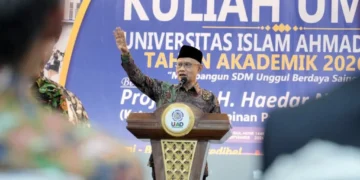


MUHAMMADIYAH.OR.ID, YOGYAKARTA – Haedar Nashir, President of Muhammadiyah Central Board, said Islam should serve as an alternative civilization rather than adopt rigid or extreme positions.

Speaking on Sunday (1/3) at the closing of the 1447 H Ramadan Sermon organized by the Muhammadiyah Provincial Board of Yogyakarta at Ahmad Dahlan University, Haedar addressed the shifting global ideological landscape.
With the decline of socialism and the dominance of capitalism, he argued, Islam offers a balanced path. It does not suppress the human drive to grow and progress. At the same time, it does not detach itself from social justice concerns often associated with socialism.
Islam, he explained, contains elements that intersect with both capitalism and socialism. However, it does not reject either system outright. Instead, from its earliest period, Islam positioned itself as an alternative when civilizations reached deadlock under overly materialistic or fatalistic frameworks.
Therefore, he urged Muslims to present Islam as a comprehensive civilizational model. Said approach, he argued, requires moderation and intellectual depth.
Ecological Civility Requires Balance, Not Reaction
Addressing the theme “Ecological Civility for the Future of the Univere,” Haedar called for a holistic perspective. Environmental issues, he stressed, should not be viewed partially or emotionally.
“Islam always forbids destruction. Yet at the same time, Islam encourages the building of civilization,” he said.
He warned against placing ecological concerns at an extreme point. According to him, Indonesia’s environmental problems largely stem from abuse of power and violations of existing regulations. Nevertheless, such realities should not halt development efforts.
As khalifah fil ardh—stewards of the earth—humans bear responsibility to cultivate and improve the world. However, development inevitably alters landscapes. Agricultural land may become educational facilities for long term benefit. The key, he noted, lies in ensuring that short-term interests do not exhaust vital resources.
Quoting Egyptian scholar Mahmoud Syaltout (1968), Haedar emphasized that stewardship must balance material and spiritual welfare. Physical well-being requires responsible use of the earth’s resources. Thus, civilization cannot grow if society focuses solely on spirituality while neglecting science and economic strength.
“Civilization cannot be built if our mindset is entirely anti-everything,” he said. “Ecology must be placed within the full dimension of life as we build civilization.”
Muhammadiyah, he concluded, must remain engaged with real human challenges. Development is permissible, but the wounds inflicted on nature must not become chronic, extreme, or widespread. Progress, therefore, must walk hand in hand with preservation.
Translator: Bintang Adrian