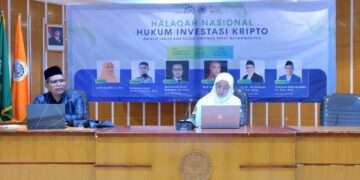


MUHAMMADIYAH.OR.ID, YOGYAKARTA — Mochammad Tanzil Multazam, a lecturer at Muhammadiyah University of Sidoarjo, outlined the practical dimensions of cryptocurrency investment and trading during the National Halaqah on Crypto Investment Law at Ahmad Dahlan University on Saturday (28/2).

In his presentation, Tanzil urged participants to understand the blockchain ecosystem in its entirety before judging crypto assets from either an investment or legal standpoint. Cryptocurrency, he argued, is essentially a byproduct of blockchain technology rather than a true currency.
“The term cryptocurrency is not entirely accurate,” he said. “In essence, it functions more as a crypto asset than as a medium of exchange.”
Initially, crypto tokens emerged as rewards for validators who verified blockchain transactions. However, as the adoption expanded, these tokens gained wider transactional use and eventually became known as digital currencies. Today, their function extends well beyond payments. They serve as collateral, investment instruments, and components of decentralized financial systems.
Because of these diverse financial roles, Tanzil maintained that the label “crypto asset” better reflects their economic nature.
Mapping the Crypto Ecosystem
Tanzil mapped the crypto ecosystem into three key components: users, platforms, and assets. Users include not only trades but also long-term holders, developers, validators or stakers, and liquidity providers. Each group, he noted, plays a distinct role in sustaining blockchain networks.
From the platform perspective, he distinguished between centralized exchanges, which operate under regulatory oversight, and decentralized finance (DeFi) systems that function without a central authority. This structural difference, he added, carries legal and risk implications.
In terms of assets, crypto projects operate across technological layers. Layer-one coins from the main blockchain networks. Layer-two tokens support scalability and transaction efficiency. Layer-three applications build digital services on top of those networks.
Although millions of crypto assets circulate globally, Tanzil emphasized that only a small fraction possess real utility.
“Out of ten of millions of crypto assets, fewer than a thousand likely offer genuine utility,” he said. “The rest tend to be speculative.”
This imbalance, he argued, often drives trading behavior that resembles gambling, especially when purchases lack clear functional value.
Strengthening Digital Financial Literacy
Tanzil also challenged the perception that crypto guarantees instant wealth. Based on his observations, substantial profits typically accrue to three groups: early adopters, investors who benefit from extreme price spikes and fraudsters.
Moreover, he warned that high-leverage futures trading frequently triggers rapid liquidation and severe losses. “The pursuit of instant riches through crypto often ends in instant bankruptcy,” he said.
As a result, Tanzil encouraged investors to rely on fundamental analysis grounded in on-chain data. Key indicators include developer activity, tokenomics structures and asset ownership distribution.
Ultimately, he concluded, financial literacy remains the most critical safeguard. With stronger understanding, the public can evaluate blockchain technology rationally rather than engage in unchecked speculation.
Translator: Bintang Adrian