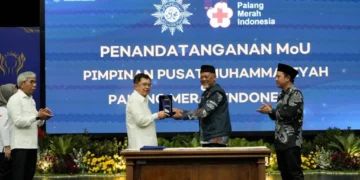


EN.MUHAMMADIYAH.OR.ID, JAKARTA — The Central Board of Muhammadiyah Disaster Management Center (MDMC), in collaboration with the United Nations Population Fund (UNFPA), held a forum titled “ZISWAF for Reproductive Health and Gender-Based Violence.”

The event brought together institutions managing zakat, infaq, alms, and waqf (ZISWAF), philanthropic organizations, and humanitarian practitioners to develop an implementation framework for ZISWAF that is more responsive to reproductive health needs and the prevention and response to gender-based violence.
Representatives from the National Alms Agency of Indonesia (BAZNAS), the Zakat Forum (FOZ), the Forum of Zakat Organizations (FOroz), the Indonesian Waqf Board (BWI), MDMC, and Lazismu attended the forum.
The event also involved facilitators from among Muhammadiyah members from Sudan, Tunisia, and Morocco, enriching the discussions through an exchange of experiences and cross-country perspectives on Islamic philanthropy and humanitarian responses.
Developing a Practical ZISWAF Framework
The event, held on Tuesday (1/9) at Hotel Cikini in Jakarta, opened with remarks from UNFPA representatives, followed by an address from Central Board MDMC Chairperson Budi Setiawan.
Budi expressed his gratitude for the forum and said he hoped the event would produce an applicable framework for ZISWAF management institutions and Islamic philanthropy practitiones.
“Alhamdulillah, this event is successful. We hope this meeting will produce a framework that makes it easier for zakat administrators and practitioners managing zakat to implement it,” Budi said.
He stressed the importance of operational guidelines to ensure the management and accountability of ZISWAF while remaining in line with sharia principles.
The framework is going to help Islamic philanthropic institutions respond to the needs of vulnerable groups, particularly those facing reproductive health issues and gender-based violence.
Supporting Compliance and Targeted Assistance
Abdoel Malik, the person in charge of the event and first deputy secretary of the Central Board MDMC, said the forum aimed to develop a working document that could serve as a reference for ZISWAF management institutions in implementing measurable programs in accordance with the regulations.
Malik explained that a draft working paper had been prepared outlining the criteria for the beneficiaries, available forms of programs support, and the types of assistance beneficiaries may receive through the eight asnaf, or eligible categories of zakat recipients, as well as through infaq and alms.
“Our intention is to make implementation easier at the management level after receiving approval from each institution’s internal sharia board and to ensure compliance with audit standards stipulated by law,” he said.
The draft working paper will provide greater clarity on beneficiary categories, forms of assistance, and the components of service accessible to target groups through ZISWAF.
Strengthening Social Protection through Islamic Philanthropy
A ZISWAF-based approach allows philanthropic institutions to optimize various religious and social resources in complementary ways while observing the distinct sharia provisions governing each instrument.
Through the collaboration between MDMC Muhammadiyah, UNFPA, and stakeholders in the ZISWAF and Islamic philanthropy sectors, the main objective is to strengthen the role of ZISWAF as an instrument of social protection.
Beyond supporting the basic needs of vulnerable communities, ZISWAF is also expected to contribute to broader efforts to ensure access to safe, dignified, and inclusive reproductive health services while strengthening the prevention of and response to gender-based violence in Indonesia. (taufik)