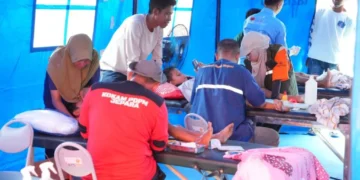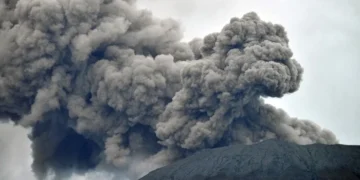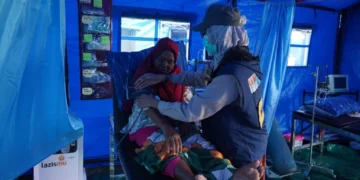


EN.MUHAMMADIYAH.OR.ID, EAST MANGGARAI — The Central Board of Muhammadiyah has expressed its appreciation to all volunteers who spent nearly three weeks responding to disasters in East Nusa Tenggara (NTT).

Hilman Latief, Treasurer General of the Central Board of Muhammadiyah, said the volunteers’ service in the field had been far from easy. Some had to leave their jobs and professional activities to provide assistance to affected communities.
“On behalf of the Muhammadiyah Central Board, I would like to thank everyone for the work carried out over these three weeks in the field. It has not been easy. Alhamdulillah, I have heard that other volunteers have arrived to take over the shifts. This is a good moment for us to maintain continuity,” Hilman said Sunday (6/9) in Dampek, East Manggarai, NTT.
For Hilman, continuity is essential to Muhammadiyah’s humanitarian work. He recalled a common saying within the organization: Muhammadiyah volunteers seek to arrive first when disaster strikes and leave only after the response has been completed.
Hilman said some of the deployed volunteers were health workers and specialist doctors who had to leave their practices while carrying out the humanitarian mission.
The sacrifice, Hilman added, reflects the religious spirit underlying Muhammadiyah’s humanitarian movement. He cited the Quranic injunction wa ta‘āwanū ‘alal-birri wat-taqwā, meaning to cooperate in righteousness and piety.
Hilman also referred to Surah Al-Balad and its discussion of al-‘aqabah, the difficult and arduous path. The passage, he said, teaches people to make concrete decisions to help others by providing food, assisting those in hardship and standing with vulnerable groups.
“We are not talking about individuals. Alhamdulillah, Muhammadiyah and, of course, other religious organizations strengthen this level of commitment, allowing us to become a collective movement,” he said.
Building a Stronger Humanitarian Response
Hilman said Muhammadiyah’s volunteer readiness was the result of a long process of internal consolidation involving the Muhammadiyah Disaster Management Center (MDMC), LAZISMU, the Council for Public Health (MPKU), and other elements of the organization.
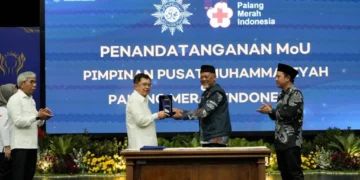
One important effort has been the development of the Muhammadiyah Emergency Medical Team (EMT), which has been prepared since 2018. The process has included strengthening volunteers’ knowledge and skills, establishing procedures, obtaining certifications and developing their readiness to work in emergencies.
“We do not want our colleagues’ commitment to be held back simply because of administrative issues,” Hilman said.
The long preparation, he added, has enabled Muhammadiyah volunteers to operate according to higher standards, both in domestic disaster responses and international humanitarian missions.
He described this progress as the result of years of collective work by MDMC, health workers, volunteers and many others who have helped build Muhammadiyah’s humanitarian capacity.
The Muhammadiyah Central Board also thanked all members of the public who contributed to the disaster response in NTT.
According to Hilman, humanitarian work requires collective strength because recovery does not happen overnight.
“A religious and humanitarian mission requires extraordinary hard work. Without strength and collective action, it would be difficult. We want to build strong human solidarity through the work we are carrying out,” he said. (taufik)