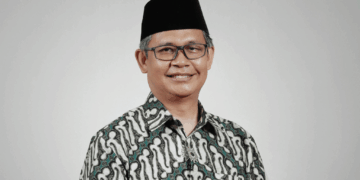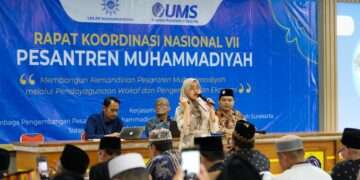


EN.MUHAMMADIYAH.OR.ID, MAKASSAR – Secretary of the Central Board of Muhammadiyah, M. Izzul Muslimin, delivered the keynote address at the 40th Anniversary celebration of Ummul Mukminin ‘Aisyiyah South Sulawesi Islamic Boarding School, held at the school’s Indoor Sports Hall in Makassar on Sunday (28/6).

The four-decade milestone served as both a moment of reflection and a strategic opportunity to prepare the future of Islamic boarding schools as institutions that are excellent, adaptive, and sustainable.
In his keynote speech, Izzul emphasized that reaching the age of 40 marks a critical stage in the life of an institution. At this point, he said, an organization should not experience decline but instead continue to grow and strengthen its contribution to both the Muslim community and the nation.
“Our hope is that after 40 years, Ummul Mukminin will not fade but continue to grow, flourish, and move forward,” he said.
The Legacy Behind the Name “Ummul Mukminin”
Izzul also highlighted the significance of the name Ummul Mukminin, which is closely associated with the exemplary character of Sayyidah Khadijah. According to him, Khadijah is remembered not only as the wife of Prophet Muhammad (peace be upon him) but also as a woman of intelligence, resilience, and extraordinary sacrifice in advancing Islam.
Therefore, choosing the name Ummul Mukminin reflects a noble aspiration to nurture Muslim women who are faithful, knowledgeable, and capable of carrying forward the mission of Islamic da’wah.
“The name Ummul Mukminin is more than just a name. It represents a great vision of producing faithful, intelligent women who will continue the mission of Islamic da’wah,” he explained.
Four Priorities for the Future of Islamic Boarding Schools
During his address, Izzul outlined four key priorities that should guide the long-term sustainability and progress of Islamic boarding schools.
The first is the ability to adapt to changing times. He stressed that pesantren must respond to social, technological, and educational developments without compromising the Islamic values that form their foundation.
The second is the importance of building sound and professional institutional governance. He encouraged educational institutions to avoid poor management practices by fostering leadership that is adaptive, open, participatory, and rooted in consultation (musyawarah) when making decisions.
The third priority is preparing sustainable leadership succession. According to Izzul, the long-term success of any institution depends on its ability to develop future leaders who possess competence, integrity, and sufficient leadership experience.
The fourth is the ability to manage conflicts wisely. He noted that every organization inevitably faces internal challenges, making healthy conflict-resolution mechanisms essential to ensuring continued institutional development.
Appreciating Four Decades of Growth
On the occasion, Izzul also praised the remarkable achievements of Pondok Pesantren Puteri Ummul Mukminin over the past four decades. He noted that the institution’s growth—from only 17 students at its founding to approximately 1,200 students today—demonstrates the success of its cadre development, institutional management, and the public’s trust.
“Hopefully, Ummul Mukminin will continue to produce outstanding and exceptional ‘Aisyiyah cadres who become pioneers of Islamic da’wah, Muhammadiyah’s mission, and even humanitarian service throughout the world,” he concluded. (Bhisma)