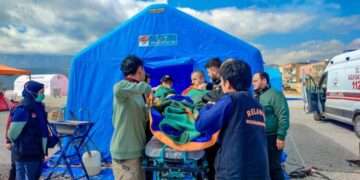


EN.MUHAMMADIYAH.OR.ID, ISTANBUL – The Coordinator of Muhammadiyah Emergency Medical Team, dr. Corona Rintawan, was invited to serve as a panelist at a high-level meeting organized by WHO Europe.

The meeting was held in Istanbul Türkiye, on July 1-2, 2026. It was focused on advancing health security through effective earthquake emergency management.
Syafiq A. Mughni, chairman of the Muhammadiyah Central Board, welcomed the organization’s participation. He described it as evidence of its expanding international role.
“Alhamdulillah, this is an honor for Muhammadiyah on the global stage. Thank you to Dr. Corona, Coordinator of Muhammadiyah’s Emergency Medical Team,” Syafiq said.
Muhammadiyah is widely recognized internationally as a faith-based organization committed to humanitarian causes. The organization has consistently contributed to humanitarian efforts in numerous countries, particularly in disaster response.
Its humanitarian engagement includes disaster relief operations in Türkiye and many other parts of the world, driven by the principles of tawhid, authentic Islamic teachings, and service to humanity.
Moreover, its participation in the WHO forum demonstrates how civil society organizations can contribute to global discussions on disaster resilience alongside governments and international institutions.
Strengthening Global Collaboration
According to dr. Corona, the high-level meeting brought together more than 250 participants from approximately 40 countries across the WHO European Region.
The meeting brought together health ministers, representatives of WHO member states, international organizations, development partners, academics, and disaster management specialists. Such a diverse gathering created opportunities for countries and humanitarian organizations to exchange knowledge and thus strengthen international partnerships.
The forum aimed to strengthen international collaboration in building resilient health systems capable of responding effectively to major earthquakes.
Sharing Best Practices in Disaster Preparedness
On the first day, participants attended technical sessions covering several key issues. These included resilient health systems, national emergency preparedness, disaster-safe hospitals, Emergency Medical Teams (EMTs), digital innovation, and the use of after-action reviews to improve future disaster responses.
Meanwhile, the second day featured a Ministerial Roundtable, where Indonesia’s Minister of Health, Budi Gunadi Sadikin, represented the country. During the session, ministers discussed policy priorities for strengthening national health systems in earthquake-prone regions.
As a result, delegates endorsed the Istanbul Outcome Statement. This is a joint declaration outlining commitments to improve health system resilience against future earthquakes.
“This meeting produced a shared commitment among health ministers to strengthen health systems against earthquake disasters through the Istanbul Outcome Statement,” Dr. Corona said.
He expressed hope that the trust placed in Muhammadiyah through its participation in the forum would further strengthen the organization’s commitment to maintaining international confidence while continuing to make meaningful contributions to global humanitarian efforts.