

MUHAMMADIYAH.OR.ID, SURABAYA – Muhammadiyah is preparing to build an infusion manufacturing plant that will utilize advanced equipment and technology sourced from Italy, a decision driven by considerations of quality and long-term durability.

The plan was outlined by Muhadjir Effendy, Chairperson of Muhammadiyah Central Board, during a visit to the Muhammadiyah Provincial Board of East Java’s Headquarters in Surabaya on Saturday, April 18.
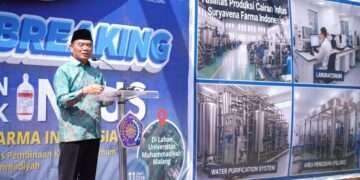
He said construction of the facility is scheduled to begin with a groundbreaking ceremony in May 2026 in Mojokerto. In addition to intravenous fluids, the plant is expected to produce medical devices such as needles, with the potential to expand into other single-use medical supplies in the future.
Strengthening Muhammadiyah’s Internal Health Industry Ecosystem
Moreover, the initiative forms part of a broader strategy to strengthen the organization’s internal economic ecosystem. Muhammadiyah currently operates around 130 hospitals and more than 400 clinics, creating a substantial and consistent demand for medical supplies.
“Instead of relying on external suppliers, we prefer to produce our own,” Muhadjir said. “This will help reduce operational costs and allow us to build a closed-loop system across our institutions.”
However, he noted that pharmaceutical production is not yet included in the current development phase.
Investment Model and Cost Efficiency
In terms of financing, the project will adopt a share-based investment model involving the network of Muhammadiyah-’Aisyiyah hospitals. Muhadjir acknowledged that the initial investment would be significant, particularly due to the use of imported Italian technology.
Nevertheless, he emphasized that the long-term benefits justify the cost. The technology, he said, offers greater durability and improved packaging quality, both of which contribute to operational efficiency.
Balancing Quality with Social Impact
Despite the high upfront costs, Muhammadiyah aims to keep its infusion products competitively priced. The approach reflects the organization’s broader philosophy of balancing business sustainability with social benefit.
“We have calculated everything carefully to ensure affordability,” Muhadjir said. “Our goal is not only to meet internal demand but also to compete in the wider market.”
Construction is expected to begin by the end of May 2026. The facility is targeted for completion before the organization’s 49th congress in 2027 and is scheduled to become fully operational by 2028.