

Talbiyah is one of the most profound declarations in the Hajj pilgrimage. It marks the beginning of ihram and reflects a Muslim’s total submission to Allah. However, during Hajj rituals, a recurring question arises: must the talbiyah be recited individually, or can it be led by a guide and repeated collectively by pilgrims?

Most scholars agree that the wording of the talbiyah, as taught by the Prophet Muhammad, is as follows:
لَبَّيْكَ اللَّهُمَّ لَبَّيْكَ، لَبَّيْكَ لَا شَرِيكَ لَكَ لَبَّيْكَ، إِنَّ الْحَمْدَ وَالنِّعْمَةَ لَكَ وَالْمُلْكَ، لَا شَرِيكَ لَكَ
It is narrated from Abdullah ibn Umar:
عَنْ عَبْدِ اللَّهِ بْنِ عُمَرَ رَضِيَ اللَّهُ عَنْهُمَا أَنَّ تَلْبِيَةَ رَسُولِ اللَّهِ صَلَّى اللَّهُ عَلَيْهِ وَسَلَّمَ: لَبَّيْكَ اللَّهُمَّ لَبَّيْكَ، لَبَّيْكَ لَا شَرِيكَ لَكَ لَبَّيْكَ، إِنَّ الْحَمْدَ وَالنِّعْمَةَ لَكَ وَالْمُلْكَ، لَا شَرِيكَ لَكَ
(رواه البخاري)
Translation: “Here I am, O Allah, here I am. Here I am, You have no partner, here I am. Indeed, all praise, blessings, and sovereignty belong to You. You have no partner.” (Narrated by al-Bukhari)
This declaration affirms that all praise, blessings and power belong solely to Allah. Therefore, talbiyah serves as both a renewal of faith and a reaffirmation of Islamic monotheism (tauhid).
Collective Recitation in Practice
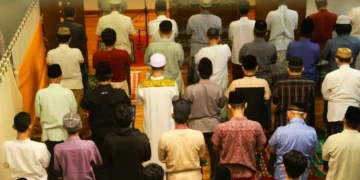
In practice, especially among organized Hajj and Umrah groups, it is common for a guide to recite the talbiyah aloud, followed by pilgrims repeating it in unison. Some consider this method inconsistent with the Sunnah, but textual evidence suggests otherwise.
A narration reported in Muslim, through companions including Abdullah ibn Mas’ud, states:
عَنْ عَبْدِ الرَّحْمَنِ بْنِ يَزِيدَ وَالْأَسْوَدِ بْنِ يَزِيدَ قَالَا سَمِعْنَا عَبْدَ اللَّهِ بْنَ مَسْعُودٍ يَقُولُ بِجَمْعٍ سَمِعْتُ الَّذِي أُنْزِلَتْ عَلَيْهِ سُورَةُ الْبَقَرَةِ هَاهُنَا يَقُولُ: لَبَّيْكَ اللَّهُمَّ لَبَّيْكَ، ثُمَّ لَبَّيْنَا مَعَهُ
(رواه مسلم)
Translation: “We heard Abdullah ibn Mas’ud say at Jam (Muzdalifah): I heard the one to whom surah Al-Baqarah was revealed (the Prophet) say here, ‘Labbaika Allahumma Labbaik,’ and then we joined him in reciting the talbiyah.” (Narrated by Muslim)
The narration indicates that the companions listened to the Prophet recite talbiyah and then followed him together. Accordingly, it provides a basis for collective recitation, whether guided or done simultaneously.
A Matter of Facilitation, Not Obligation
Therefore, reciting the talbiyah under a leader’s command is not prohibited. In fact, for large groups, this method can help maintain accuracy and prevent confusion.
However, it is important to understand that such coordination is not a requirement for validity. Talbiyah remains valid whether recited individually, quietly, aloud, or collectively.
Ultimately, what matters most is sincerity and adherence to the wording taught by the Prophet. The use of a leader’s guidance serves only as a practical aid, not as an essential component to the ritual.
Reference:
Central Board of Muhammadiyah, “Tuntunan Manasik Haji”, in Berita Resmi Muhammadiyah: Tanfidz Keputusan Musyawarah Nasional Tarjih XXVIII, 2015.