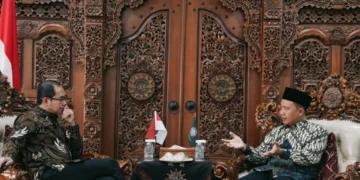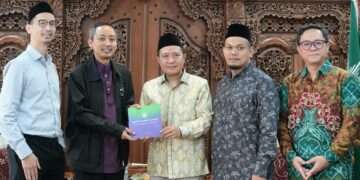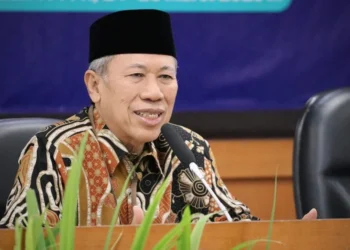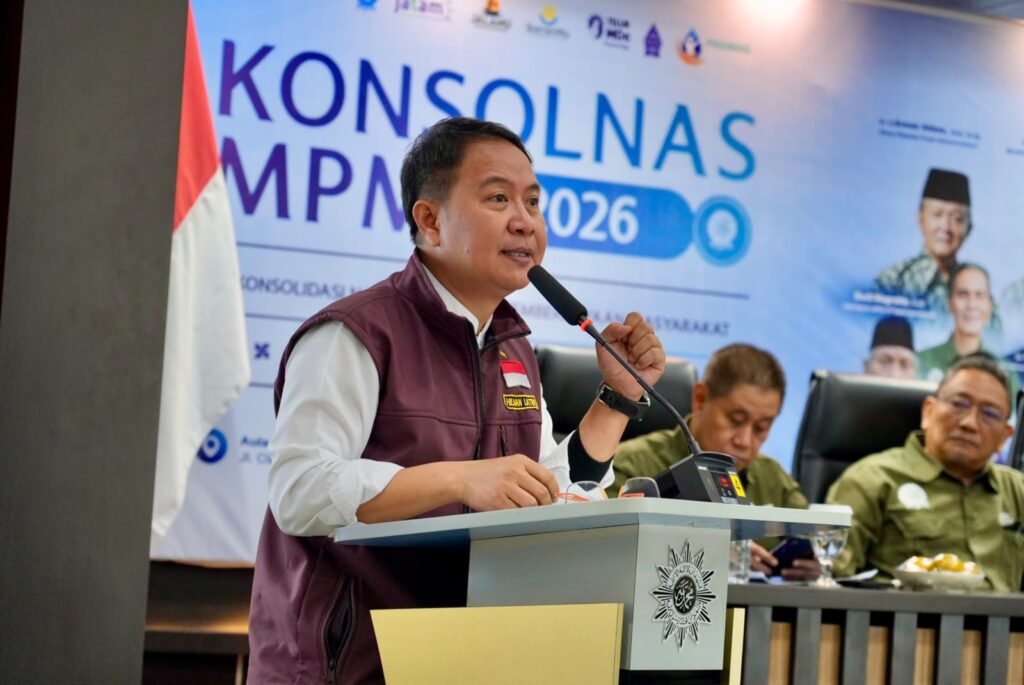
EN.MUHAMMADIYAH.OR.ID, YOGYAKARTA – The Treasurer of the Central Board of Muhammadiyah, Hilman Latief, delivered a strategic message at the National Consolidation of the Central Board of Muhammadiyah’s Council for Community Empowerment (MPM).

In his remarks, Hilman emphasized the need for MPM to level up. The council must not only strengthen its community empowerment initiatives but also expand its work onto the international stage. He outlined three key points that deserve in-depth consideration.
First, Hilman explained that as a council focused on community empowerment, MPM should serve as a platform for education while establishing a clear philosophical foundation for its work.
“We need to strengthen the philosophical foundation. What is the philosophy behind the Community Empowerment Council? We need a definition that is clear, clean, and precise. What does empowerment mean? What exactly do we mean by empowerment?” he said.
Hilman also highlighted MPM’s achievements and contributions. He said the council’s significant work for Muhammadiyah and Indonesia should be taken to the next level and receive formal recognition, first from national institutions and eventually from international organizations.
MPM Must Improve Its Administration
He offered a critique, noting that MPM needs to improve its reporting and organizational administration.
Hilman stressed that MPM’s performance should not rely solely on hard work in the field. It must also be supported by smart work, leveraging digital technology, young human resources, and a clear roadmap for the future.
“We have worked incredibly hard in the field. The movement is already there, but I want to invite MPM activists to move to a higher level. To calculate, to count, to examine the impact!” he emphasized.
Continuing his remarks, Hilman encouraged MPM to measure its Social Return on Investment (SROI) and align its work with the Sustainable Development Goals (SDGs).
“If we prepare this properly, then at or even before the upcoming congress, we can present MPM to national and international institutions, as well as government agencies and the private sector, to seek recognition. But before that, our reports and documentation must be clear,” he concluded. (Bhisma)