

EN.MUHAMMADIYAH.OR.ID, BANDUNG – Din Syamsuddin, who served as the President of Muhammadiyah from 2005 to 2015, has called on the organization to take a greater role in protecting and empowering Indonesian migrant workers.

He said Muhammadiyah is well positioned to contribute through diplomacy, mentoring programs, and skills training for prospective migrant workers before they leave Indonesia.
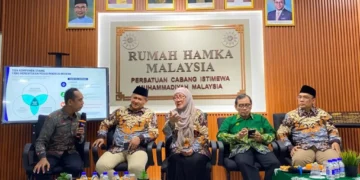
Speaking at the Muhammadiyah Diplomacy Training (MDT) program organized by the International Relations and Cooperation Department of Muhammadiyah, Din emphasized that migrant workers face challenges at every stage of the migration process.
The event took place at the KH Ahmad Dahlan Auditorium, Universitas Muhammadiyah Bandung on Saturday (6/6).
Three Critical Stages of Migration
According to Din, the migrant worker experience consists of three phases: before departure, while working abroad, and after returning home.
Each stage presents vulnerabilities that require serious attention and protection.
“Every phase contains risk points that often create problems for migrant workers,” Din said. “Because labor placement involves many parties, opportunities for unfair practices still exist.”
He identified limited education and skills among some prospective migrant workers as one of the main concerns during the pre-departure stage.
Such conditions can make workers more vulnerable to exploitation and create difficulties when adapting to new workplaces and cultures abroad.
As a result, they may face unfair treatment or struggle to exercise their rights in destination countries.
A Role for Muhammadiyah
Din argued that Muhammadiyah can help address these challenges through its extensive network of institutions, community organizations, and social enterprises.
He encouraged the organization to provide training, orientation programs, and ongoing support for prospective migrant workers.
“This is an area that remains wide open for Muhammadiyah,” he said. “Proper preparation and training can help migrant workers face challenges abroad while reducing various risks, including sexual harassment, which often affects female migrant workers.”
He added that strengthening workers’ skills and preparedness would improve both their safety and their opportunities for success overseas.
Building Diplomatic Capacity
Meanwhile, Herry Suhardiyanto, rector of Muhammadiyah University of Bandung, praised the initiative and described diplomacy as an essential tool for advancing national interests and protecting Indonesian citizens abroad.
He expressed hope that Muhammadiyah would produce more cadres with expertise in international relations and diplomacy.
The two-day training program brought together several prominent figures, including Syafiq A. Mughni, Zulfikar Ahmad Tawalla, ambassadors, and senior Muhammadiyah leaders. The event also featured Imam Addaruqutni and Ahmad Imam Mujadid Rais.
Advancing Humanitarian Diplomacy
The program forms part of Muhammadiyah’s broader effort to strengthen its role in humanitarian and national diplomacy on the global stage.
Through leadership development and collaboration with government agencies, diplomats, and civil society organizations, Muhammadiyah hopes to contribute more effectively to the protection and empowerment of Indonesian migrant workers.
Organizers described migrant workers as a vital national asset whose welfare deserves sustained attention, both at home and abroad.