

EN.MUHAMMADIYAH.OR.ID, YOGYAKARTA – Salah (five daily prayers) is the only religious obligation in Islam that remains mandatory under virtually all circumstances, according to a senior Muhammadiyah scholar who urged Muslims to deepen their understanding of the practice rather than perform it merely out of habit.

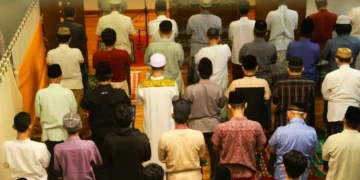
Speaking at a religious study session titled The Secrets of the Five Daily Prayers at KH Sudja Mosque on Monday (1/6), Budi Jaya Putra said prayer occupies a unique position among Islamic obligations.
“Unlike other acts of worship, prayer cannot be abandoned as long as a person remains conscious and capable of performing it,” he said.
He explained that Islamic law provides accommodations for worshippers facing physical limitations. Those unable to stand may pray while sitting. If sitting is impossible, they may pray while lying down. When movement becomes difficult, gestures can substitute for physical motions.
Even those who miss a prayer because they forget or fall asleep must perform it as soon as they remember or awaken, he added.
Prayer obligations cease only in specific situations, such as before puberty, during menstruation or postpartum bleeding for women, or after death.
More Than Ritual Movements
Budi began his lecture by examining the linguistic and theological meaning of prayer.
He noted that the Arabic word shalat originates from a term meaning supplication or prayer. As a result, nearly every recitation within Islamic prayer contains elements of invocation and devotion, from the opening supplication to the final salutations.
The term also relates to blessings, he said, citing a Quranic verse that states that God and the angels send blessings upon the Prophet Muhammad.
“When we invoke blessings upon the Prophet, we do so as an expression of honor and recognition of his noble status,” Budi explained.
In Islamic jurisprudence, prayer consists of specific words and actions that begin with the opening declaration of God’s greatness and conclude with greetings of peace.
Worship Requires Study
Budi expressed concern that many Muslims learn prayer solely by observing others without studying its foundations.
According to him, prayer follows clear guidelines and cannot be based on personal preference or improvisation.
“Prayer is not simply a matter of copying movements that we happen to see,” he said. “Muslims must learn its recitations, pillars and proper procedures according to the Prophet’s teachings.”
He pointed to common mistakes in both recitation and physical movements that often persist across generations because people imitate one another without examining the original sources.
For that reason, he said, the Prophet Muhammad’s instruction to “pray as you have seen me pray” requires careful learning and study of authentic traditions.
“If one person copies another, and that person copied someone before him, mistakes can continue indefinitely,” he said.
A Direct Command From God
Budi also discussed the origins of the five daily prayers, which most Islamic scholars trace to the Prophet Muhammad’s Night Journey and Ascension.
According to widely accepted traditions, the Prophet initially received a command to perform 50 prayers each day. After repeated requests for relief, inspired by the advice of the Prophet Moses, the obligation was reduced to five daily prayers while retaining the spiritual reward of fifty.
“If many people still struggle to perform five prayers, imagine if the number had remained fifty,” Budi said.
He emphasized that prayer enjoys a special status because God commanded it directly to the Prophet Muhammad, unlike many other religious obligations delivered through the Angel Gabriel.
The Quran repeatedly commands believers to establish prayer, including in a verse that instructs them to pray, pay alms and bow alongside other worshippers.
According to Budi, such verses refute interpretations that reduce prayer to merely remembering God internally without performing its prescribed actions.
Among them is the belief that prayer will become the first deed evaluated on the Day of Judgment. If a person’s prayer is sound, he said, the rest of their deeds are more likely to be accepted. If it is deficient, other deeds may also suffer.
“The first thing examined is not wealth, fasting, almsgiving or pilgrimage,” he said. “It is prayer.”
He even joked that anyone searching for a future son-in-law should first examine the quality of his prayers before considering other qualities.
Budi also cited a prophetic tradition describing prayer as the defining distinction between Muslims and non-Muslims.
“A Muslim is called to stand before God five times every day,” he said.
In addition, prayer serves as a moral safeguard. When performed sincerely and consistently, it helps restrain individuals from immoral and harmful behavior.
A Path to Spiritual Purification
Budi concluded by discussing prayer as a means of spiritual cleansing.
Drawing on prophetic traditions, he explained that the five daily prayers, weekly Friday prayers and the annual observance of Ramadan all provide opportunities for the forgiveness of minor sins, provided that believers avoid major transgressions.
Each prayer, he said, offers a chance for renewal, self-correction and spiritual growth.
At the end of the session, Budi encouraged worshippers to safeguard their prayers and cultivate the same commitment within their families.
He stressed the importance of cooperation between parents in teaching children to maintain prayer as a central pillar of faith.
“Let us continue to guard our prayers,” he said, “and remind one another within our families to remain steadfast in fulfilling this obligation that stands as a pillar of religion.”
The First Deed Judged
Budi highlighted several virtues associated with prayer in Islamic teaching.
Among them is the belief that prayer will become the first deed evaluated on the Day of Judgment. If a person’s prayer is sound, he said, the rest of their deeds are more likely to be accepted. If it is deficient, other deeds may also suffer.
“The first thing examined is not wealth, fasting, almsgiving or pilgrimage,” he said. “It is prayer.”
He even joked that anyone searching for a future son-in-law should first examine the quality of his prayers before considering other qualities.
Budi also cited a prophetic tradition describing prayer as the defining distinction between Muslims and non-Muslims.
“A Muslim is called to stand before God five times every day,” he said.
In addition, prayer serves as a moral safeguard. When performed sincerely and consistently, it helps restrain individuals from immoral and harmful behavior.
A Path to Spiritual Purification
Budi concluded by discussing prayer as a means of spiritual cleansing.
Drawing on prophetic traditions, he explained that the five daily prayers, weekly Friday prayers and the annual observance of Ramadan all provide opportunities for the forgiveness of minor sins, provided that believers avoid major transgressions.
Each prayer, he said, offers a chance for renewal, self-correction and spiritual growth.
At the end of the session, Budi encouraged worshippers to safeguard their prayers and cultivate the same commitment within their families.
He stressed the importance of cooperation between parents in teaching children to maintain prayer as a central pillar of faith.
“Let us continue to guard our prayers,” he said, “and remind one another within our families to remain steadfast in fulfilling this obligation that stands as a pillar of religion.”