Friday, October 2, 2026
  • AR
  • ENG
  • IDN
Muhammadiyah Media
  • EDUCATION
  • HEALTH
  • ECONOMY
  • HUMANITY
  • OTHERS
    • RELIGION
    • LAW & POLITICS
    • IDEOLOGY
    • SOCIO-CULTURE
    • ENVIRONMENT
    • MEDIA
No Result
View All Result
  • Login
Muhammadiyah Media
  • EDUCATION
  • HEALTH
  • ECONOMY
  • HUMANITY
  • OTHERS
    • RELIGION
    • LAW & POLITICS
    • IDEOLOGY
    • SOCIO-CULTURE
    • ENVIRONMENT
    • MEDIA
No Result
View All Result
  • Login
Muhammadiyah Media
No Result
View All Result
  • EDUCATION
  • HEALTH
  • ECONOMY
  • HUMANITY
  • OTHERS
Home News

The Crescent Controversy: Unity and Debate about the Unified Global Hijri Calendar

by Persyarikatan Muhammadiyah
1 year ago
in News, Religion
Reading Time: 3 mins read
A A
The Crescent Controversy: Unity and Debate about the Unified Global Hijri Calendar

The proposal of a Unified Global Hijri Calendar continues to spark debate. While this effort aims to unify Muslims worldwide under a single lunar calendar, it has drawn criticism, especially from those who uphold traditional, local moon-sighting practices. Muhammadiyah, one of Indonesia’s largest Islamic organizations and a strong supporter of the unified global Hijri calendar, welcomes these criticisms as part of a healthy scholarly discourse.

One major concern raised by critics is that the the unified global Hijri calendar may require certain regions to begin a new lunar month even if the crescent moon (hilal) has not been physically sighted there, or to delay it in regions where it has, in order to maintain global uniformity. This is especially controversial in cases where the hilal is still below the horizon in eastern regions.

Such criticism generally emerges from a local sighting paradigm (rukyat) that the visible appearance of the moon is considered essential. In contrast, the unified global Hijri calendar relies on global astronomical calculations and the concept of a shared visibility zone (matlak), drawing on a different interpretation of both shar’i arguments and celestial events.

In traditional understanding, the hilal is the crescent moon that becomes visible after conjunction. However, classical fiqh literature doesn’t always delve into the scientific detail behind moon phases. This leaves room for clarification, especially for those who still prioritize local moon sightings.

According to Muhammadiyah’s astronomy expert, Arwin Juli Rakhmadi Butar-Butar, the scientific reasoning behind the unified global Hijri calendar can be summarized in three main arguments.

Lunar Phases as Global Phenomena

Lunar phases, including the emergence of the hilal, are global astronomical phenomena. The visibility of the crescent may vary by location, but its existence is not in question. Once the conjunction (ijtima’) occurs, the alignment of the sun and moon, the new moon technically begins, even if the hilal is still below the horizon and not visible to the naked eye. Arwin refers to Surah Yasin (36:39): 

RelatedArticle

Cyberbullying Takes Many Forms, from Flaming to Doxing

Studying in Northern Ireland, Muhammadiyah Cadre Shares Insights on Campus Life and Community Engagement

Catholic Nun Earns Master’s in Midwifery at UNISA Yogyakarta, Strengthening Interfaith Brotherhood

وَالْقَمَرَ قَدَّرْنَاهُ مَنَازِلَ حَتَّىٰ عَادَ كَالْعُرْجُونِ الْقَدِيمِ

“And the moon – We have determined for its phases, until it returns [appearing] like the old date stalk. 

This interpretation suggests that the hilal exists as soon as the conjunction happens. Its visibility is a local issue, but its existence is global. Therefore, even if the crescent is below the horizon in some areas, the new month has technically begun.

Astronomical Dynamics and Elongation

The changing shape of the moon is related to elongation—the angular distance between the sun and the moon. This distance increases after conjunction, gradually making the crescent visible. This dynamic is referenced in Surah Yasin (36:40): 

.لَا الشَّمْسُ يَنْبَغِي لَهَا أَنْ تُدْرِكَ الْقَمَرَ وَلَ اللَّيْلُ سَابِقُ النَّهَارِۚ وَكُلٌّ فِي فَلَكٍ يَسْبَحُونَ

“It is not for the sun to overtake the moon, nor does the night outstrip the day. And each is swimming in an orbit.”

As elongation increases, the moon that is initially invisible in one region will soon appear in others. Thus, if the crescent meets the visibility criteria (imkanu rukyat) in any part of the world, it should be considered valid globally, even for areas where it remains below the horizon.

Geographical Reality and Legal Precedent

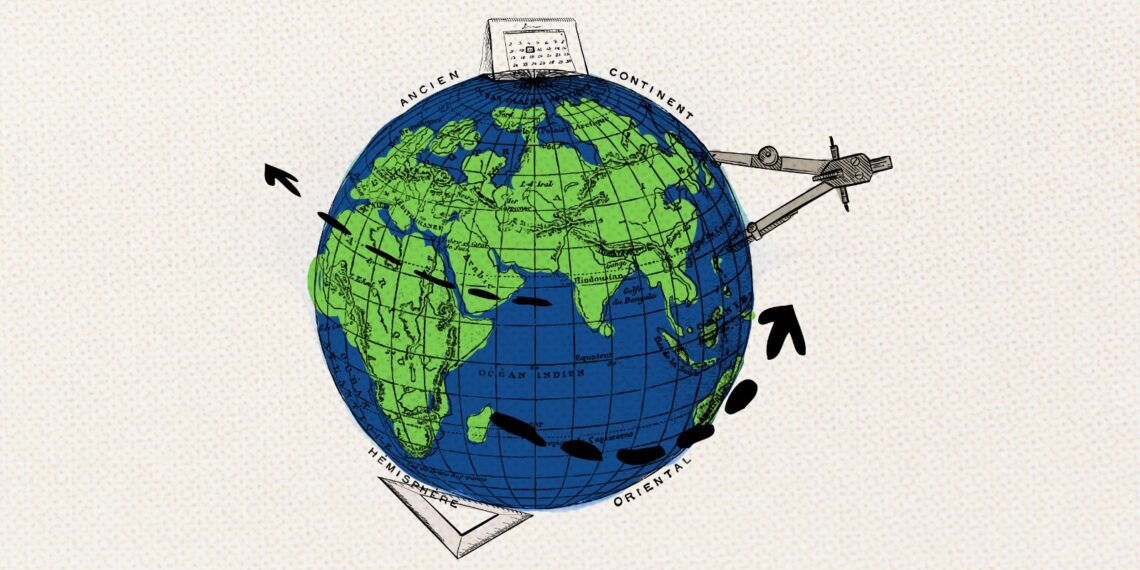
Due to Earth’s rotation, western regions generally have a better chance of sighting the crescent than eastern ones. Islamic legal scholars (fuqaha) have long recognized this and stated that if the crescent is seen in the east, it applies to the west. 

This reinforces the idea that a sighting in one part of the world can be accepted for others, aligning with the universal nature of lunar observations in rukyat hadiths.

From these perspectives, the unified global Hijri calendar is not only based on Islamic teachings but also in modern scientific understanding. Recognizing the crescent’s existence even when it’s not yet visible marks a shift from seeing the hilal as merely a local physical event to understanding it as a global astronomical reality.

This shift offers a practical and unifying solution for the Muslim world, where differing calendars often lead to disjointed observances of major religious events. The unified global Hijri calendar draws on the Prophet’s guidance that a lunar month lasts 29 or 30 days and is determined by the moon’s cycle, which is now accurately measurable through science.

Despite its confidence in the unified global Hijri calendar, Muhammadiyah remains open to further discussion and constructive feedback, in line with the Islamic tradition of ongoing inquiry and refinement.

Reference:
Butar-Butar, A. J. R. (2024, March). Hilal di bawah ufuk dalam KHGT. OIF UMSU. https://oif.umsu.ac.id/2024/03/hilal-di-bawah-ufuk-dalam-the-unified-global-hijri-calendar/


Tags: hijri calendarIslamic calendarunified global hijri calendar
ShareTweetSendShareShare
Previous Post

The Only Eastern Indonesian Private University Recognized in THE Rankings 2025

Next Post

Zheng He International Peace Forum and Muhammadiyah Collaborate to Address Global Muslim Issues

RelatedPosts

Eid al-Adha 1447 H to Fall on Wednesday, May 27, 2026
Islamic Law

Eid al-Adha 1447 H to Fall on Wednesday, May 27, 2026

29 April 2026
Dhu al-Hijjah 1447 to Begin on Monday, May 18, 2026, Under Global Hijri Calendar
Islamic Law

DzulHijjah 1447 H to Begin on Monday, May 18, 2026

28 April 2026
Muhammadiyah Study Center Partners PCIM Saudi to Promote the Unified Global Hijri Calendar
News

Muhammadiyah Study Center Partners PCIM Saudi to Promote the Unified Global Hijri Calendar

28 April 2026
The Urgency of a Unified Global Hijri Calendar
News

Are Authority and Scope of Applicability essential for the Unified Global Hijri Calendar?

23 October 2025
Next Post
Zheng He International Peace Forum and Muhammadiyah Collaborate to Address Global Muslim Issues

Zheng He International Peace Forum and Muhammadiyah Collaborate to Address Global Muslim Issues

Zheng He Forum and Muhammadiyah Discuss Issues of Muslims, Global Peace, and Security

Zheng He Forum and Muhammadiyah Discuss Issues of Muslims, Global Peace, and Security

Download Ebooks of the Unified Global Hijri Calendar

Download Ebooks of the Unified Global Hijri Calendar

Populer News

  • National Narcotics Agency Commends Muhammadiyah’s Efforts in Eradicating Drug Abuse

    National Narcotics Agency Commends Muhammadiyah’s Efforts in Eradicating Drug Abuse

    0 shares
    Share 0 Tweet 0
  • Fatwa on Using Mirin in Cooking for Muslims in Japan

    0 shares
    Share 0 Tweet 0
  • The Islamic Character of Lionel Messi

    0 shares
    Share 0 Tweet 0
  • Is It Permissible for Muslims to Blow Out Birthday Candles?

    0 shares
    Share 0 Tweet 0
  • Safa and Marwa: Uncovering the Historical Depths of Two Sacred Hills

    0 shares
    Share 0 Tweet 0
  • Man of Action, Man of Dialogue: The Legacy of KH Ahmad Dahlan

    0 shares
    Share 0 Tweet 0
  • Leader’s Profile: dr. H. Agus Taufiqurrohman, Sp.S., M.Kes.

    0 shares
    Share 0 Tweet 0
  • Leader’s Profile: Drs. H. A. Dahlan Rais, M.Hum.

    0 shares
    Share 0 Tweet 0
  • Can One Animal Serve Both Aqiqah and Qurban? 

    0 shares
    Share 0 Tweet 0
  • Leader’s Profile: M. Sayuti, M.Pd., M.Ed., Ph.D.

    0 shares
    Share 0 Tweet 0

Council

  • Religious Opinion & Tajdid
  • Religious Preaching
  • Higher Education, Research, & Development
  • Elementary, Secondary, & Non-Formal Education
  • Cadre & Human Resources
  • Public Health
  • Social Welfare
  • Economy, Business, & Tourism
  • Waqf Utilization
  • Community Empowerment
  • Law and Human Rights
  • Enviromental Preservation
  • Publications & Information

Institutions

  • Islamic Boarding School
  • Branch & Mosque Development
  • Strategic Studies & Partnerships
  • Financial Supervision & Development
  • Disaster Management Center
  • Charity Management
  • Micro, Small, & Medium Enterprise
  • Politics & Public Policy
  • Arts & Culture
  • Sports & Development
  • International Relations & Cooperation
  • Community Da'wah
  • Halal Auditing & "Halalan Thayyiban" Studies
  • Hajj & Umroh
  • Legal Aid & Public Advocacy

Bureau

  • Organization Development
  • Financial Management
  • Communication & Public Services

Ortom

  • 'Aisyiyah Woman Association
  • Muhammadiyah Youth Association
  • Nasyiatul 'Aisyiyah Young Woman Association
  • Muhammadiyah University Student Association
  • Muhammadiyah Student Association
  • Muhammadiyah Tapak Suci Martial Arts
  • Muhammadiyah Hizbul Wathan Scouts

Sumatra Region

  • Nanggroe Aceh Darussalam
  • Sumatra Utara
  • Sumatra Selatan
  • Sumatra Barat
  • Bengkulu
  • Riau
  • Kepulauan Riau
  • Jambi
  • Bangka Belitung

Kalimantan Region

  • Kalimantan Barat
  • Kalimantan Timur
  • Kalimantan Selatan
  • Kalimantan Tengah
  • Kalimantan Utara

Jawa Region

  • D.I. Yogyakarta
  • Banten
  • DKI Jakarta
  • Jawa Barat
  • Jawa Tengah
  • Jawa Timur

Bali & Kepulauan Nusa Tenggara

Region

  • Bali
  • Nusa Tenggara Barat
  • Nusa Tenggara Timur

Sulawesi Region

  • Gorontalo
  • Sulawesi Barat
  • Sulawesi Tengah
  • Sulawesi Utara
  • Sulawesi Tenggara
  • Sulawesi Selatan

Maluku dan Papua Region

  • Maluku Utara
  • Maluku
  • Papua
  • Papua Barat
  • Papua Barat daya

Special Branch

  • Kairo Mesir
  • Iran
  • Sudan
  • Belanda
  • Jerman
  • United Kingdom
  • Libya
  • Malaysia
  • Prancis
  • Amerika Serikat
  • Jepang
  • Tunisia
  • Pakistan
  • Australia
  • Rusia
  • Taiwan
  • Tunisia
  • TurkI
  • Korea Selatan
  • Tiongkok
  • Arab Saudi
  • India
  • Maroko
  • Yordania
  • Yaman
  • Spanyol
  • Hongaria
  • Thailand
  • Kuwait
  • New Zealand

Category

  • Education
  • Health
  • Economy
  • Humanity
  • Religion
  • Law & Politics
  • Ideology
  • Culture
  • Media

About

  • History
  • Brand Guideline

Services

  • Information

Apps

  • Muhammadiyah ID
  • MASA
  • EventMu
  • BukuMu
  • SehatMu
  • KaderMu
  • LabMu

More Information

  • Editorial
  • Contact
  • Privacy Policy
© 2024 Persyarikatan Muhammadiyah

Welcome Back!

Login to your account below

Forgotten Password?

Retrieve your password

Please enter your username or email address to reset your password.

Log In

Add New Playlist

No Result
View All Result
  • icon bendera arab
  • bendera indonesia
  • EDUCATION
  • HEALTH
  • ECONOMY
  • HUMANITY
  • OTHERS
    • RELIGION
    • LAW & POLITICS
    • IDEOLOGY
    • SOCIO-CULTURE
    • ENVIRONMENT
    • MEDIA
  • Login

© 2024 Persyarikatan Muhammadiyah - Cahaya Islam Berkemajuan.