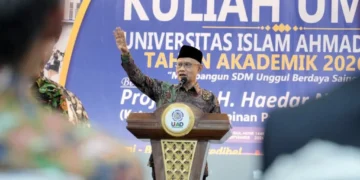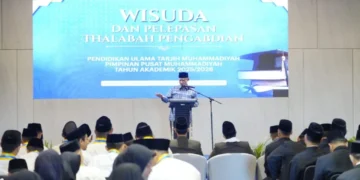


MUHAMMADIYAH.OR.ID, SIDOARJO – The wide and evenly distributed network of Muhammadiyah educational institutions across the country, including those reaching remote areas, is intended to erode cultural maladies and cultivate a progressive culture.

The President of Muhammadiyah Central Board, Haedar Nashir, explained that the cultural maladies afflicting the Indonesian nation, as identified by Prof. Koentjaraningrat, consist of four main characteristics.
These four cultural problems include a tendency to take shortcuts, a lack of genuine discipline, a low appreciation for time, and a lack of future orientation, manifested in the habit of consuming resources for immediate gratification.
“I hope Muhammadiyah schools can become nurseries of a higher culture leading toward a progressive civilization. It must begin with small things such as discipline,” he said on Saturday (31/01).
Muhammadiyah’s Progressive Movement
Haedar emphasized that the progress envisioned by Muhammadiyah is progress grounded in divine values. This foundation, he noted, is what distinguishes Muhammadiyah’s concept of progress from that of Western modernity.
“Almost everything is similar. The key lies in the four dimensions of progress mentioned earlier. But there is one one that is most fundamental in Islamic civilization, namely divine values,” Haedar Nashir explained.
For Muhammadiyah, progress is not merely a slogan shouted aloud, but must be implemented through concrete and tangible works. One such manifestation is the increasing number of Muhammadiyah-’Aisyiyah Universities (PTMA) that have achieved superior accreditation status.
Through the development of educational institutions, Muhammadiyah hopes to reclaim the golden age of Islamic civilization. That is an Islamic excellence that once played a major role in enlightening the world, from east to west.
A progressive civilization, Haedar continued, encompasses various systems of life. This includes livelihoods, organizational structures, knowledge, religion, the arts, the economy, technology, and other social institutions shaping human life.
Therefore, Haedar invited the Indonesian people to begin to change from small habits, starting with discipline. Based on his experience, Indonesians are often able to be discipline when abroad, yet tend to relapse into old habits once they return home.
The recurring relapse, he explained, reflects a lack of genuine discipline. In contrast, within a Muslim’s character, situational morality should not exist.
From there, society must move on to larger endeavors: advancing education and knowledge so as to generate competitive technology and economic strength. Thus, building a progressive civilization is a long-term process that requires sustained effort and commitment.
Translator: Bintang Adrian