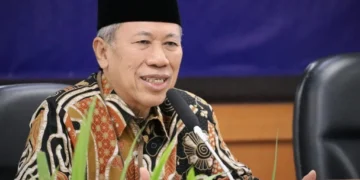


MUHAMMADIYAH.OR.ID, YOGYAKARTA — “Character and mentality building is not instant, it must be cultivated through daily habit.”

The argument is stated by Arif Jamali Muis, Special Advisor of the Ministry of Primary and Secondary Education (Kemendikdasmen RI), in Seminar of Education: “Instilling the Character of Great Students towards a Golden Indonesia through 7 Habits of Great Children” coordinated by Muhammadiyah Study Center in SM Tower Malioboro, Yogyakarta on Thursday (09/10).
In his remarks, Arif emphasized that Kemendikdasmen strive to find an applicable character building pattern for a formal education environment. According to him, there are plenty of character building theories, but only a few are applicable.
The ministry, therefore, opted to apply a simple approach that is easy to understand and could be implemented directly by students, teachers, and parents.
“We want to avoid being too theoretical. Thus, we decided to declare the ‘7 Habits of Great Children’ that is practical, easy to grasp, and could directly be integrated into children’s daily life.
The seven great habits are: waking up early, worshipping, exercising, eating healthy and nutritious food, loving to learn, contributing to the community, and sleeping early. Arif further explained each of the habits and its relation to Islamic values and Muhammadiyah spirit.
“Waking up early is a very Islamic habit,” he explained. “It’s impossible for Muslims, especially Muhammadiyah cadres, to be lazy to wake up early. This must become a fundamental character trait, because those who rise early have a strong spirit for life and discipline.”
The second habit, worship or prayer, according to Arif is nothing new for Muslims. He emphasized the importance of making worship a spiritual foundation that strengthens every dimension of a student’s life.
Meanwhile, the habit of exercising receives special attention.
“This is not just about children, it also involves teachers and parents. In the ministry’s program, we have Pagi Ceria (Cheerful Morning), which combines nationalism, sports, and spirituality through singing the national anthem, doing morning exercises, and praying. If Muhammadiyah schools don’t implement this, that would be quite odd,” he said with a smile.
Arif also highlighted the importance of healthy and nutritious eating habits. He cited the Free Nutritious Meal (MBG) program as a good example, proven to boost student performance in several countries.
“Many of our youth suffer from diabetes and obesity due to poor eating patterns. That’s why nutrition education must become part of character building,” he explained.
The fifth habit, a love of learning, he said, is a hallmark of Muhammadiyah students. However, Arif reminded us that loving to learn is not merely about reading books. It must be accompanied by curiosity and a willingness to contribute positively to society.
The sixth habit, social engagement, serves as a reflective critique of today’s younger generation, who often spend more time on their phones.
“In the past, children would play soccer after school. Now they get absorbed in social media. As a result, they become more prone to sadness and anxiety. Yet, the human brain develops through social interaction.” he explained.
Finally, sleeping early. He pointed out that many young people today have become a generasi kalong (nocturnal generation), staying up late into the night.
“The quality of night sleep cannot be replaced by sleeping in the morning. God has designed our bodies to rest at night and be active during the day. This is the human fitrah (nature),” he stressed.
Arif asserted that these seven habits are not only schools’ responsibility, but also families’ and society at large. At the Ministry of Primary and Secondary Education, this approach is called Universal Participation, meaning the involvement of all parties in shaping the character of the nation’s children.
“We want our children to be not only academically intelligent but also of noble character. From waking up early to sleeping early, everything is a form of character training,” he concluded. (Bintang Adrian)