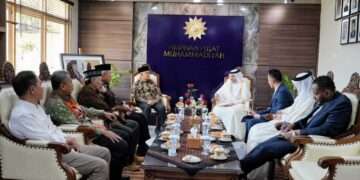


EN.MUHAMMADIYAH.OR.ID, JAKARTA – The Central Board of Muhammadiyah welcomed a delegation from teh Persatuan Wadah Pencerdasan Umat Malaysia (WADAH) on Wednesday (29/7) at the Muhammadiyah Headquarters in Jakarta.

The meeting marked an initial step toward strengthening bilateral ties and exploring collaboration in leadership development, youth cadre training, and the advancement of Islamic movements across Southeast Asia.
Hilman Latief, Treasurer of the Central Board of Muhammadiyah, said the discussion centered on strategic issues that Islamic organizations must address in the future, including leadership development, contemporary challenges, and the effective use of emerging technologies.
“We have just held discussions with our guests from Malaysia, particularly from WADAH, which is essentially a cadre-development organization closely connected with youth movements there,” he said.
According to Hilman, Islamic organizations in Southeast Asia need to expand their international engagement by addressing strategic global isses such as the Sustainable Development Goals (SDGs), environmental sustainability, technological advancement, and artificial intelligence (AI).
“We discussed strategic issues concerning leadership and contemporary challenges, as well as how Islamic organizations should reassert their presence on the international stage by engaging with broader issues such as the SDGs, environmental concerns, and developments in technology and AI,” he explained.
He added that both organizations also explored opportunities to strengthen leadership training programs for young people throughout Southeast Asia.
“We hope to collaborate in strengthening leadership training across Southeast Asia among Islamic organizations and movements,” Hilman said.
Expanding Islamic Leadership for a Global Future
He further emphasized that youth organizations in the region should not limit their focus to domestic concerns only. Rather, they should also prepare themselves to respond to global challenges in technology, the economy, healthcare, and humanitarian affairs.
“The concerns of the Muslim community are broad—they involve preparing for the future and responding to challenges in technology, economics, healthcare, and many other areas. Islamic movements must contribute through ideas as well as human resources. We want to build a stronger vision for Southeast Asia,” he stressed.
Meanwhile, WADAH Secretary General Tuan Haji Azizuddin Ahmad described the visit as an important first step toward strengthening relations and opening wider opportunities for collaboration with Muhammadiyah.
“Alhamdulillah, I have had the opportunity to visit Muhammadiyah and meet Professor Hilman. This is my first meeting with him, but I believe it marks the beginning of a stronger relationship and our joint efforts to find ways of working together to strengthen the Islamic movement,” he said.
Azizuddin expected the partnership to be able to foster smarter youth development while helping Islamic organizations prepare for future challenges.
He praised Muhammadiyah’s long-standing experience in advancing da’wah, education, and its extensive network of charitable and social institutions, both in Indonesia and internationally.
“We believe Muhammadiyah has extensive experience in da’wah both in Indonesia and abroad. Other than that, we see tremendous potential within Muhammadiyah, especially its many best practices. We need to conduct case studies, engage in discussions, and benchmark these successful programs,” he said.
Azizuddin expressed hope that Muhammadiyah’s experience could serve as a valuable reference for Islamic organizations throughout the ASEAN region. He added that the partnership between WADAH and Muhammadiyah is expected not only to strengthen relations between the two organizations but also to provide guidance and support for Islamic movements across Southeast Asia. (Taufik)