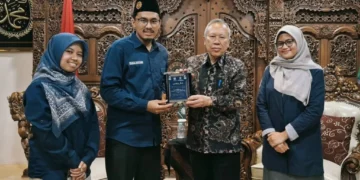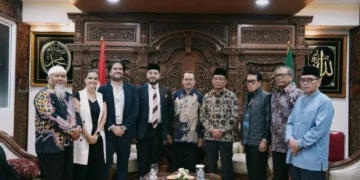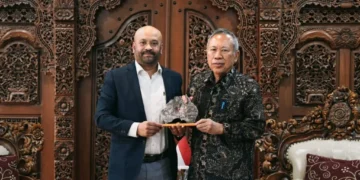

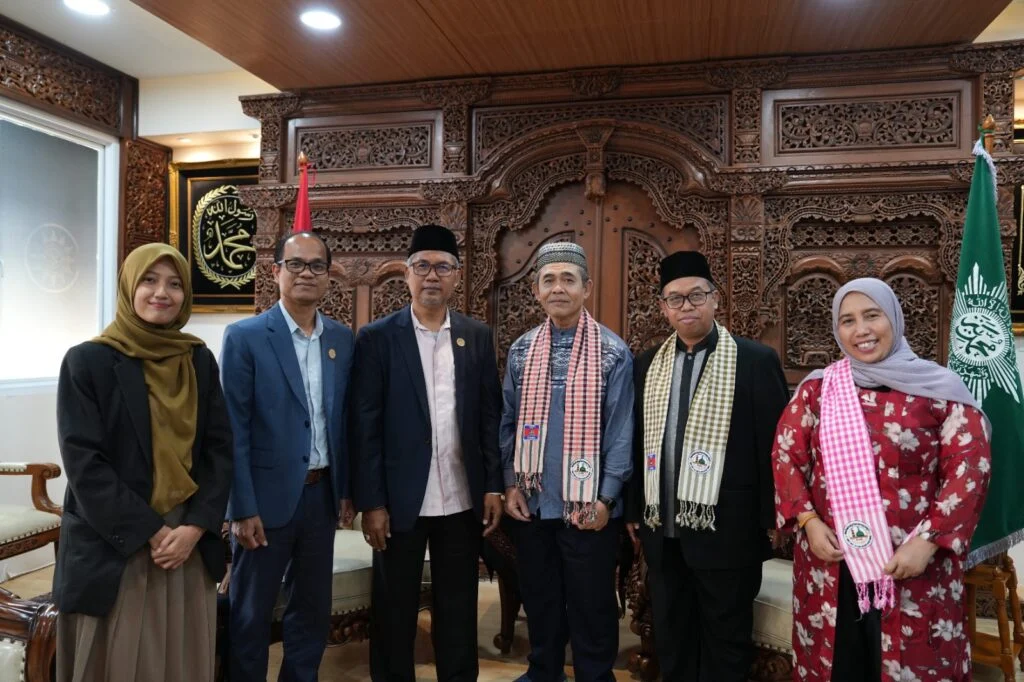
EN.MUHAMMADIYAH.OR.ID, JAKARTA — The Central Board of Muhammadiyah received a visit from Cambodia’s Grand Mufti at its Jakarta Headquarters on Monday (28/9). They are discussing potential cooperation in Islamic education, human resource development, and environmental initiatives.

The delegation was received by Mohammad Mas’udi, Vice Chairperson of the Central Board’s Council for Religious Opinion and Reform. He was accompanied by Ghoffar Ismail, a member of the Council for Religious Opinion and Reform, along with Hening Parlan, Vice Chairperson of the Central Board’s Council for Environmental Preservation.
During the meeting, Hening Parlan introduced Muhammadiyah’s organizational structure, councils and departments, autonomous organizations, and affiliated educational and social enterprises. Muhammadiyah also outlined various programs in education, religious affairs, health care, social services, and environmental protection.
Meanwhile, Cambodia’s Grand Mufti, Sheikh Yahya Yusof, described the current conditions of the Muslim community and Islamic education in Cambodia. Among the challenges, he said, are limited human resources and difficulties in managing Islamic schools.
Cambodia currently has around 634 Islamic schools serving more than 71,000 students. About 1,500 teachers receive government support, while another 900 teachers work as volunteers.
Yahya expressed hope that Muhammadiyah’s experience in managing educational institutions could serve as a reference for strengthening the capacity of teachers, school principals and Islamic education administrators.
“Our capabilities are still limited. Our school management practices are also limited. Through this visit, we hope that in the future we can cooperate, particularly in the areas of teachers and students,” he said.
Such cooperation could also help Islamic schools in Cambodia become more self-reliant. Some schools still depend on aid and donations because they have yet to establish independent sources of funding.
Linking Islamic Education and Environmental Action
Beyond education, the Cambodian delegation expressed interest in developing environmental initiatives integrated with Islamic education. This was identified as another potential area of cooperation through Muhammadiyah’s Environmental Preservation Council.
The meeting also explored academic ties between Muhammadiyah-affiliated universities and educational institutions in Cambodia. Potential cooperation could include student exchanges, training programs, research, and community service.
Mohammad Mas’udi also explained the religious approach used to address contemporary issues through the bayani, burhani, and irfani approaches. These approaches integrate religious sources, scientific knowledge, and considerations of public benefit when responding to contemporary challenges.
Mas’udi said cooperation with Cambodia should take into account the country’s social and religious context. He stressed that Muhammadiyah’s international development should be pursued by understanding the culture and characteristics of the communities in each country.
“If we go to Cambodia, we have to understand Cambodia as it is. We must not disrupt the existing culture. We have to begin with things that we already have in common,” he said.
The meeting formed part of Muhammadiyah’s efforts to strengthen relations with the Muslim community in Cambodia. Islamic education, human resource development, and environmental initiatives were identified as several areas that could be developed through future cooperation. (Taufik)