

EN.MUHAMMADIYAH.OR.ID, SURAKARTA – Abdul Mu’ti, secretary general of the Central Board of Muhammadiyah, reaffirmed the organization’s commitment to combating corruption during a visit to Muhammadiyah Regional Board of Surakarta, warning that no country can achieve sustainable progress while corruption continues unchecked.

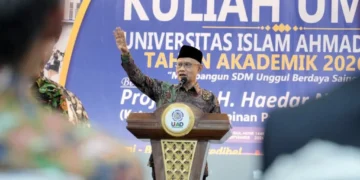
Addressing thousands of Muhammadiyah and ‘Aisyiyah members at the Muhammadiyah Da’wah Hall on Sunday (31/5), Mu’ti said corruption remains one of the greatest obstacles to national development. He stressed that strong commitment is needed to establish both clean government and good governance at every level of public administration.
In his speech, Mu’ti quoted the influential book Why Nations Fail. He noted that systemic uncontrolled corruption has long been identified as a major reason why nations stagnate or collapse.
“There is simply no story of a nation plagued by rampant corruption that has gone on to succeed,” he said.
Corruption as a Moral and National Challenge
Mu’ti argued that the fight against corruption is not merely a political or legal agenda. Instead, he said, it is also a moral imperative deeply rooted in Islamic teachings.
He pointed to the Qur’anic instruction for humanity to reflect on the rise and fall of past civilizations. According to him, many great societies declined not only because of economic weakness or political instability. Many societies, instead, declined because their leaders abused power and abandoned integrity.
For that reason, he said Muhammadiyah sees anti-corruption efforts as an essential part of its broader mission to build a civilized and progressive society.
At the same time, Mu’ti urged Muhammadiyah members not to fall into pessimism about Indonesia’s current challenges. Rather, he called on them to become role models of honesty, trustworthiness, and ethical leadership in all sectors of public life.
Public Trust as Muhammadiyah’s Greatest Asset
Mu’ti emphasized that Muhammadiyah’s greatest strength lies in the trust it has built over more than a century.
He pointed to the substantial charitable endowments entrusted to the organization by the public as evidence of that confidence.
“In this era of mutual distrust, Muhammadiyah continues to be trusted to manage endowments worth billions,” he said. “That trust did not fall from the sky. It is social and moral capital that must inspire us to do even better.”
He stressed that this public confidence must be protected through transparent, professional, and accountable organizational governance.
With that foundation, Mu’ti said, Muhammadiyah has the responsibility and the opportunity to make a meaningful contribution to national reform.
Closing his remarks, he expressed hope that Muhammadiyah would continue to embody independence, progress, and ethical leadership.
He said the organization must remain an example (uswah hasanah and qudwah) for society in upholding honesty and integrity, while contributing to the realization of transparent governance free from corruption. (Bhisma)