

MUHAMMADIYAH.OR.ID, JEMBER – Syafiq A. Mughni, Chairperson of Muhammadiyah Central Board, is calling on Muslims to rethink their religious perspectives to address the global environmental crisis.

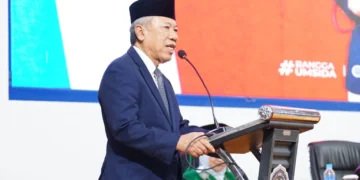
During a seminar at the Muhammadiyah University of Jember on Sunday (22/2), Syafiq introduced the principle of ecotheology as a vital solution. He explained that human history has long fluctuated between two major worldviews: theocentrism and anthropocentrism.
Theocentrism places God at the center of all things. “All of life is devoted to Allah. Every action is directed to fulfill the Divine will,” Syafiq explained.
However, he noted that this view suffered distortions in the past. For example, during the dominance of the church in the west, religious authorities controlled scientific debates. This situation often led to the stagnation of human knowledge and scientific discovery. Consequently, a reaction occurred in the form of anthropocentrism.
Anthropocentrism shifts the focus by placing humanity at the center of the universe. In this framework, reason and science become the primary measures of truth.
Syafiq believes both approaches offer important insights. Theocentrism reflects our relationship with God (habluminallah), while anthropocentrism concerns our relationships with other humans (habluminannas). Nevertheless, modern challenges suggest that these two pillars are no longer sufficient to sustain our planet.
Expanding the Scope of Religious Responsibility
“It is not enough for us to only have good relations with Allah and fellow humans. We must also have good relations with other creatures and the environment,” Syafiq stated firmly.
He argued that the traditional concepts of religious duty must expand to include the natural world. The climate crisis serves as undeniable proof that environmental destruction impacts all life on earth. If global temperatures continue to rise without control, humans and animals alike will face extinction.
Therefore, Syafiq introduced the terms habluminbi’ah (relationship with the environment) and habluminhayawan (relationship with other living creatures). He insists that religious life should not stop at vertical or social dimensions. Instead, faith must encompass a deep responsibility for all of God’s creations.
“Protecting the environment is not merely a social or scientific issue. It is part of our religious responsibility as vicegerents on earth,” he concluded.
In this context, ecotheology acts as a necessary synthesis. It balances the divine dimension with human needs and the preservation of nature. As the global environmental threat grows, this middle path offers a spiritual framework for survival. (Bhisma)