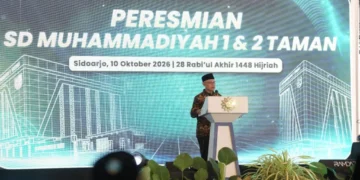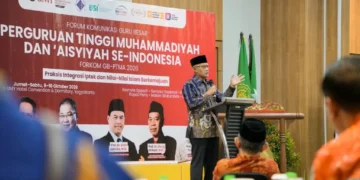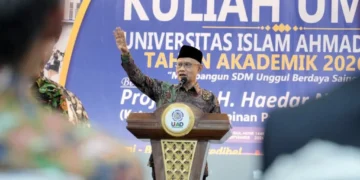


MUHAMMADIYAH.OR.ID, YOGYAKARTA – Haedar Nashir, President of Muhammadiyah, urged universities to serve as centers of inclusive Islamic outreach and the development of a progressive civilization.

He delivered the remarks during a Syawalan gathering and the inauguration of the Muhammadiyah Sub-branch Board of Gadjah Mada University, held at the University Club Hotel on Tuesday (15/4). The event brought together university leaders and academics, highlighting the strategic role of higher education in shaping society.
Haedar emphasized that campus-based branches differ fundamentally from territorial ones. Therefore, he said, outreach efforts must adapt to the dynamic and diverse nature of academic environments. They should foster comfort, strengthen cohesive relationships, and promote inclusivity. “Campuses are dynamic spaces,” he said. “Muhammadiyah must present itself as a welcoming home for all, both for the nation and for humanity at large.”
Reviving Intellectual Tradition in a Changing World
Moreover, Haedar underscored the importance of reviving the spirit of Iqra, the foundational principle of reading and knowledge in the Qur’an. He argued that this intellectual tradition once enabled Islamic civilization to flourish by integrating scientific inquiry with faith.
Such integration, he said, strengthens both the relationship with God (hablun minallah) and with fellow human beings (hablun minannas). Consequently, Muhammadiyah must continue to offer an alternative civilizational model amid global currents that often promote secular humanism.
“From communities and congregations to campuses and schools, we must continue striving to educate society and the nation,” he said.
However, Haedar also warned against the risks of excessive focus on practical politics. In his view, political polarization can divide perspectives into opposing camps, thereby weakening clarity of thought and leading to unwise actions. “Practical political orientation often divides us into allies and adversaries,” he said, “and that can obscure sound judgment.”
Navigating Digital Challenges and Expanding Global Engagement
In addition, he highlighted the dual nature of social media. While it can serve as a powerful tool for education, it also has the potential to spread misinformation. Therefore, he called on Muhammadiyah members to embody the qualities of ulil albab: individuals who think critically, filter information carefully, and act for the greater good.
Haedar encouraged campus-based cadres to strengthen Islamic outreach through wisdom (hikmah), constructive advice (mau’izhah hasanah), and meaningful dialogue. He also stressed that outreach should extend across various sectors, including education, health, social services, economics, and culture.
Finally, he emphasized Muhammadiyah’s growing global role, particularly through its higher education institutions. At a time of ongoing international conflicts, he urged academics and members to engage in strategic advocacy on the global stage.
Even small contributions, he noted, can help promote a more just and peaceful world order. As a result, he expressed optimism that Muhammadiyah would continue to earn public trust in advancing its mission of enlightened and progressive outreach.
Through the role of educators and scholars, he concluded, universities can nurture a generation that is not only intellectually capable but also morally grounded, ready to contribute to society, the nation, and humanity at large. (Bhisma)