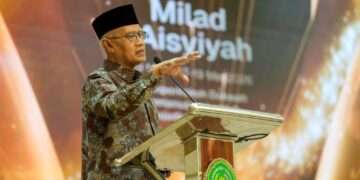


MUHAMMADIYAH.OR.ID, BANDUNG — Haedar Nashir, President of Muhammadiyah, highlighted the brutality of Israeli genocide carried out by the Zionist and its allies. He says that the failure of the global order to stop it has shaken the foundations of modern Western civilization.

The Israeli genocide against the Palestinian people, including recent developments involving Iran, demonstrates, according to Haedar, that the modern world order which claims to uphold humanitarian values has collapsed.
Haedar explained that the pro-humanitarian spirit once promoted by modern society gave rise to secular humanism—a worldview centered entirely on human values. However, he said the foundation of that paradigm have become paralysed amid ongoing wars and conflicts.
“All modern paradigms continue to be constructed as if they have never been and will never be torn apart by the same kinds of events. But what we have witnessed over the past decades, especially since 1948 and in recent years, is that the paradigm of pro-humanism has nearly failed,” Haedar said on Sunday evening (8/3) at Masjid Salman ITB during a Tarawih prayer and sermon.
According to Haedar, the legal and moral framework of the International community failed to stop the tragic global situation . He argued that international law and moral norms appear powerless because they have failed to restrain the drive to destroy the sovereignty of nations.
Callout on Muslim Community Worldwide
Haedar firmly described many of today’s conflicts as forms of modern neo-colonialism. In response to these conditions, he called on Muslims around the world to strengthen unity, sovereignty, and independence amid the uncertain global situation.
“The Muslim world, which is based on faith, should live in brotherhood. When conflicts arise among them, they should seek reconciliation and peace so that they may receive God’s mercy,” he said.
Although the theological message about unity among Muslims has been clearly stated in Surah Al-Hujarat verse 10 of the Qur’an, Haedar acknowledged that implementing this message remains difficult in reality. The complexities of political and social life, he said, make unity challenging to achieve.
“There are many competing interests at play. Even at the level of the ummah itself, it is not easy to maintain independence, unity, and a shared civilization,” he explained.
Haedar also pointed out that Islamic cosmopolitanism historically positioned Islam as a religion of enlightenment that helped unite and advance global civilization and human life between the years 700 and 1200 CE.
Translator: Bintang Adrian