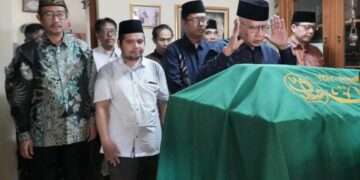


EN.MUHAMMADIYAH.OR.ID, YOGYAKARTA—Tributes continue to pour in following the passing of Prof. Hamim Ilyas, with Muhammadiyah leaders remembering him as a humble scholar whose forward-looking ideas remained deeply rooted in practical service to society.

During a virtual memorial gathering held on Sunday, colleagues and senior figures reflected on his intellectual contributions, personal humility, and enduring influence within Muhammadiyah.
Among the ideas most frequently recalled was his proposal to distribute zakat al-fitr throughout the year. This is a concept that many now regard as one of his most impactful contributions to contemporary Islamic philanthropy.
Rethinking Zakat Distribution
Hilman Latief, Muhammadiyah General Treasurer, recalled his close collaboration with Hamim through Lazismu, where Hamim previously served on the institution’s Sharia Supervisory Board before becoming chairman of Muhammadiyah Council for Religious Opinion and Reform.
Hilman said Hamim played a vital role in addressing the complex challenges of zakat management.
One issue involved the overwhelming volume of zakat al-fitr collected on the eve of Eid al-Fitr, often making immediate distribution difficult.
“He offered a practical solution and personally understood the realities on the ground. He was aware that on takbir night, Lazismu receives thousands of zakat payments, and distributing them all within such a limited timeframe is extremely challenging,” Hilman said.
Hamim proposed that zakat al-fitr distribution should be more strategic, allowing it to provide sustained support to low-income families rather than short-term relief.
“Through this idea, impoverished communities would receive benefits not only for one or two days, but throughout the year,” Hilman said.
Scholarship Beyond Specialization
Hilman also expressed pride that Hamim had recently been appointed to the Sharia Supervisory Board of a major bank.
Although his formal academic background focused on Qur’anic exegesis, Hamim demonstrated exceptional mastery of Islamic economic and legal matters.
Hilman particularly highlighted Hamim’s book Fikih Akbar, which he described as a compelling articulation of Islam as rahmatan lil ‘alamin — a mercy to all creation.
“We were deeply impressed by how the book explains Islam’s compassionate principles operating in real life,” he said.
A Scholar Grounded in Community
Bachtiar Dwi Kurniawan remembered Hamim as a professor in substance long before his formal academic promotion.
“Even before receiving the title, he had already fully earned the stature of a professor,” he said.
Bachtiar described him as an inspiring mentor whose simplicity and humility made him especially beloved among younger Muhammadiyah cadres.
He also recalled collaborating with Hamim to strengthen Muhammadiyah’s ideological formation through Baitul Arqam training programs.
“His spirit was extraordinary, even when his physical condition had already weakened significantly,” Bachtiar said.
Meanwhile, Dahwan Mukhrodji emphasized that despite serving at Muhammadiyah’s highest national level, Hamim remained actively involved at the grassroots.
“He stayed deeply engaged at the local branch level, helping manage mosques and serving the surrounding community,” he said.
Their reflections portray Hamim Ilyas as more than a national Islamic intellectual. He was a scholar who paired visionary thought with practical service, remaining close to ordinary worshippers while shaping Muhammadiyah’s theological and social direction for the future.