

The Friday sermon (khutbah) is an inseparable part of the Friday prayer. Through it, the preacher delivers religious guidance, moral teachings, and reminders that serve as provisions for the lives of Muslims. Therefore, worshippers are instructed to listen attentively and avoid anything that may diminish their concentration and reverence.

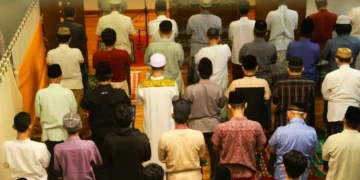
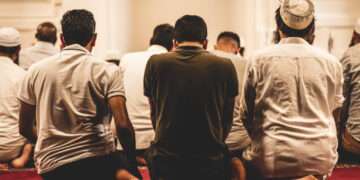
In some mosques, however, questions arise due to the physical layout of the prayer hall. Certain pulpits are positioned beside the mihrab and extend into the prayer rows. It causes some worshippers in the front rows to end up facing away from the pulpit during the Friday sermon.
This raises an important question: Is it permissible to face away from the pulpit during the Friday sermon?
The Sunnah of Facing the Preacher
In principle, facing the preacher while the sermon is being delivered is a recommended Sunnah practice. It was observed by the Companions of the Prophet Muhammad (peace be upon him). Abdullah ibn Mas’ud reported:
عَنْ عَبْدِ اللَّهِ بْنِ مَسْعُودٍ رَضِيَ اللَّهُ عَنْهُ قَالَ: كَانَ رَسُولُ اللَّهِ صَلَّى اللَّهُ عَلَيْهِ وَسَلَّمَ إِذَا اسْتَوَى عَلَى الْمِنْبَرِ اسْتَقْبَلْنَاهُ بِوُجُوهِنَا
“Whenever the Messenger of Allah (peace be upon him) stood upright on the pulpit, we would turn our faces toward him.” (HR. at-Tirmidzi)
This narration shows that the Companions directed their attention toward the Prophet during his sermon. Such behavior reflected both respect and desire to listen carefully to his guidance.
However, scholars explain this hadith indicates recommendation rather than obligation. There is no explicit textual evidence requiring every worshipper to physically face the preacher throughout the sermon. The primary objective of the Shariah is not merely bodily orientation but attentive listening and sincere engagement with the sermon.
The Main Requirement: Listening Attentively
The central emphasis during the Friday sermon is listening carefully and maintaining silence. The prophet (peace be upon him) said:
عَنْ أَبِي هُرَيْرَةَ قَالَ قَالَ رَسُولُ اللَّهِ صَلَّى اللَّهُ عَلَيْهِ وَسَلَّمَ: مَنْ تَوَضَّأَ فَأَحْسَنَ الْوُضُوءَ ثُمَّ أَتَى الْجُمُعَةَ فَاسْتَمَعَ وَأَنْصَتَ غُفِرَ لَهُ مَا بَيْنَهُ وَبَيْنَ الْجُمُعَةِ وَزِيَادَةُ ثَلَاثَةِ أَيَّامٍ، وَمَنْ مَسَّ الْحَصَى فَقَدْ لَغَا
“Whoever performs ablution properly, then comes to Friday prayer, listens attentively and remains silent, will have his sins forgiven between that Friday and the next, plus three additional days. But whoever plays with pebbles has engaged in idle behavior.” (HR. Muslim)
This hadith highlights two key requirements: istima’ (listening attentively) and inshat (remaining silent and focused). Even playing with pebbles during the sermon in the Prophet’s time was considered a distraction.
In today’s context, activities such as talking, scrolling through a mobile phone, texting, or engaging in other distractions are even more likely to undermine the spirit of attentive listening.
Therefore, a person who cannot physically face the pulpit because of the mosque’s layout can still attain the virtues of Friday prayer as long as they sincerely listen to the sermon and avoid distractions.
The Virtue of the Front Rows
In some cases, the pulpit extends into the prayer rows. It causes worshippers sitting in the front row may naturally find themselves facing away from it. This situation is often unavoidable because Islam strongly encourages Muslims to fill the front rows first.
The Prophet (peace be upon him) said:
لَوْ يَعْلَمُ النَّاسُ مَا فِي النِّدَاءِ وَالصَّفِّ الْأَوَّلِ ثُمَّ لَمْ يَجِدُوا إِلَّا أَنْ يَسْتَهِمُوا عَلَيْهِ لَاسْتَهَمُوا
“If people knew the reward of the call to prayer and the first row, and they could not obtain it except by drawing lots, they would certainly draw lots for it.” (HR. al-Bukhari)
This hadith demonstrates the immense virtue of praying in the first row. Consequently, worshippers are not encouraged to leave the front rows merely to find a position that allows them to face the pulpit more directly. The priority remains filling and straightening the front rows.
Understanding the Maqāṣid al-Sharī‘ah
From the perspective of the objectives of Islamic law (maqāṣid al-sharī‘ah), facing the preacher is a means of helping worshippers focus on the sermon. However, when mosque architecture makes this difficult, the primary objective can still be achieved through attentive listening.
For this reason, worshippers who happen to face away from the pulpit because of the mosque’s design should not be considered at fault. Their Friday prayer remains valid, and they continue to receive the reward of listening to the sermon as long as they observe the proper etiquette prescribed by Islam.
Nevertheless, if feasible, mosque administrators may wish to reconsider the placement of the pulpit so that worshippers can more easily face the preacher. It allows the worshipper to follow the practice of the Prophet (peace be upon him) and his Companions. Such arrangements would allow this Sunnah to be observed more completely while preserving the comfort of the congregation.
Reference:
The Council for Religious Opinion and Reform of the Central Board of Muhammadiyah, “Hukum Jamaah Salat Jumat yang Mendengarkan Khutbah sambil Membelakangi Mimbar”