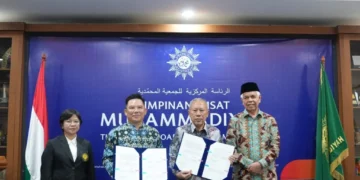


MUHAMMADIYAH.OR.ID, YOGYAKARTA – The Central Board of Muhammadiyah (PP Muhammadiyah) on Monday (12/01) welcomed Imad Abu Kishek, President of Al-Quds University, for a high-level meeting in Yogyakarta, marking a new step toward academic and humanitarian collaboration focused on Palestine and global peace.

The meeting took place on the 10th floor of the Ahmad Dahlan Building at Ahmad Dahlan University (UAD). During the discussion, both sides explored strategic opportunities for cooperation, particularly in higher education, collaborative research, and humanitarian initiatives for the Palestinian people.
Syafiq Mughni, Chairperson of Muhammadiyah Central Board, said the organization views Al-Quds University as a strategic partner. More broadly, he explained, the partnership reflects Muhammadiyah’s long-standing commitment to humanitarian advocacy and global peace, especially in relation to Palestine.
“Muhammadiyah has carried out various humanitarian projects for the Palestinian people,” Syafiq said at the meeting. “We believe Muhammadiyah and Al-Quds University can support and strengthen each other through many forms of cooperation in the future.”
He added that partnerships among educational institutions serve a dual purpose. On one hand, they enhance academic quality. On the other, they help cultivate global awareness, justice, and a shared commitment to peace. For Muhammadiyah, he said, education remains a key pathway for advancing humanitarian values on an international scale.
Building Solidarity Through Academic Exchange
Imad Abu Kishek, the president of Al-Quds University, expressed deep appreciation for Muhammadiyah’s consistent support for peace and humanitarian causes in Palestine. According to him, Jerusalem, where Al-Quds University is based, holds profound historical and spiritual significance for Muslims worldwide.
Because of the significance, he said, the city requires sustained attention and solidarity from the international community. “Jerusalem urgently needs our concern,” Imad said. “We have lived in darkness for a long time. Still, we must continue to light candles of hope for our fellow Muslims.”
Imad, who is also a professor of public policy, emphasized that educational cooperation can play a vital role in fostering that hope. Student exchanges, joint research projects, academic publications, and public forums, he noted, can function as bridges between societies. Moreover, such initiatives can help build fair and sustainable international relationships.
“This is why we see it as essential to establish ties with Muhammadiyah universities,” he said. “Today, we will sign a memorandum of understanding to begin a longer journey with Muhammadiyah and the Indonesian people.”
As a follow-up, Muhammadiyah and Al-Quds University are preparing several strategic initiatives. Among them are plans to establish a Palestine Museum in Jakarta and a Muhammadiyah representative office within Al-Quds University. These efforts are, then, expected to serve as tangible symbols of shared commitment to educational diplomacy, sociocultural exchange, and global humanitarian engagement.
Through this collaboration, Muhammadiyah reaffirmed its role as a progressive Islamic movement with influence beyond Indonesia. In doing so, the organization aims to contribute actively to global peace through education and humanitarian action, with Palestine remaining at the center of its international concern. (bhisma)
Translator: Bintang Adrian