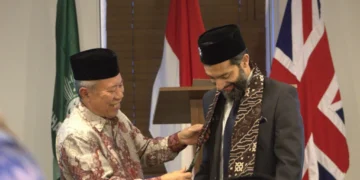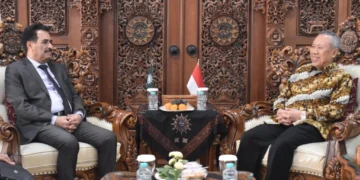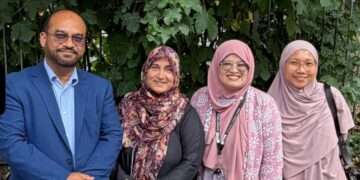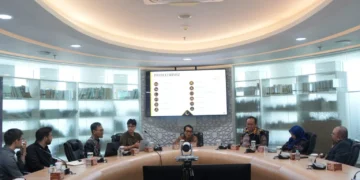


EN.MUHAMMADIYAH.OR.ID, JAKARTA – The Central Board of Muhammadiyah signed a memorandum of understanding with Thailand’s Southern Border Provinces Administrative Centre (SBPAC) on Monday (10/8) at the Muhammadiyah Headquarters in Jakarta.

The agreement seeks to strengthen ties between the two sides, particularly in education. It includes plans for a scholarship program for people from southern Thailand.
SBPAC is an official administrative body of the Thai government. It oversees development, coordination, and efforts to address issues in Thailand’s southern border provinces. These include Pattani, Yala, and Narathiwat, as well as parts of Songkhla, where most residents are Malay Muslims.
The MoU provides an initial framework for scholarships for students and prospective students from southern Thailand. They would study at Muhammadiyah-affiliated universities.
Muhammadiyah Central Board Chairperson Syafiq Mughni said the organization’s Council for Higher Education, Research, and Development (CHERD) would handle the technical follow-up. The council will coordinate the program with Muhammadiyah-‘Aisyiyah Universities.
“The follow-up will be entrusted to the CHERD, which will coordinate the activities with Muhammadiyah-’Aisyiyah Universities,” Syafiq said.
The two sides have not yet fixed the scholarship amounts or the costs they will cover. Instead, Muhammadiyah will discuss those details with the universities where the students will study.
“Once it is handed over to the Central Board of Muhammadiyah, we will discuss the scholarship quota and how much of the students’ needs it should cover with the university where they study,” he said.
This approach, Syafiq said, would allow the program to reflect both students’ educational needs and each university’s capacity.
Expanding Muhammadiyah Presence in Southern Thailand
The agreement could also open more opportunities for young people from southern Thailand to study within Muhammadiyah institutions. That includes boarding schools run by the organization.
“We also discussed informally the possibility of children from southern Thailand studying or boarding at Muhammadiyah pesantren. God willing, we will be able to accommodate them,” Syafiq said.
For Syafiq, the partnership reflects Muhammadiyah’s broader effort to benefit communities beyond Indonesia. The organization brings extensive experience and networks in education to the partnership.
“What we are doing is seeking to provide the greatest possible benefit, including for southern Thailand,” he said.
Muhammadiyah’s presence in southern Thailand already has an established foundation. The Muhammadiyah Association of Thailand is based in Yala. It also operates educational institutions serving local children.
Meanwhile, Muhammadiyah-affiliated universities have sent students to southern Thailand for community service programs.
Syafiq said the KKN program has benefited both sides. Indonesian students gain firsthand experience living and learning in a different social environment. Some also have the opportunity to learn Thai.
“Community service programs have a positive impact on both sides. Our students gain experience living in a community that differs from their own environment. They also learn some Thai,” Syafiq said.
Those experiences remain valuable after students return to Indonesia. They bring home new perspectives and stories that they can share with their peers.
They bring back useful insights and experiences to share with their colleagues,” he added.
Local communities also benefit from direct interaction with Indonesian students. Such exchanges allow residents to meet Indonesians while gaining new perspectives and experiences.
“Likewise, communities in southern Thailand benefit from the students’ presence. They can get to know one another, experience a different environment and gain valuable lessons from Indonesian students,” Syafiq said.
The Central Board of Muhammadiyah also wants to support the organization’s development in southern Thailand. Syafiq said Muhammadiyah’s presence there forms part of its broader efforts in Islamic outreach and community development.
“We are Muhammadiyah, an organization with an established system in Thailand. We will continue to encourage Muhammadiyah’s development in southern Thailand,” he said.
He believes the approach can respond to the needs of Muslim communities in southern Thailand. Muhammadiyah, he said, is open, rational, and democratic, while remaining committed to social progress.
“I believe the kind of Islam desired by people in southern Thailand is the Islam Muhammadiyah promotes. Muhammadiyah is open, rational, and democratic, and it promotes progress,” Syafiq said.
Staff Exchange Also Under Consideration
The meeting also explored a potential staff exchange between institutions in southern Thailand and Muhammadiyah institutions. The program could give participants professional experience while deepening their understanding of each side’s institutions and communities.
Under the proposed arrangement, staff from southern Thailand could work with Muhammadiyah institutions for one to two months. Muhammadiyah staff and lecturers could likewise visit and take part in similar activities in Thailand.
The two sides also discussed a cost-sharing arrangement. Thailand would cover travel from Thailand to Indonesia, while Muhammadiyah would cover expenses during the visitors’ stay in Indonesia. The arrangement would work in reverse for Muhammadiyah staff and lecturers visiting Thailand.
The staff exchange is not part of the MoU signed Monday. However, both sides see it as a potential area for future cooperation.
Syafiq said he hoped the agreement would lead to concrete programs rather than remain a ceremonial commitment.
“The Muhammadiyah Central Board appreciates SBPAC’s willingness to establish this cooperation. We pray that the agreements in this MoU can be followed up with concrete action,” he said. (taufik)