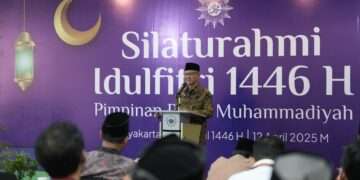


MUHAMMADIYAH.OR.ID, BANDUNG—A reflective sermon at the Subuh Mengaji gathering on Saturday (28/3) addressed a familiar concern among Muslims: the decline in religious devotion after Ramadan. The session featured Ayi Yunus Rusyana, Vice Chairman of the West Java Provincial Board of Muhammadiyah, who urged believers to rethink how they approach the month of Shawwal.

In his remarks, Ayi emphasized that Shawwal is not an endpoint. Instead, it marks the beginning of a continued effort to sustain and even elevate one’s faith. However, he acknowledged that maintaining consistency in worship after Ramadan is not easy. Many, he said, treat Ramadan as a “finish line,” completing a month of intense devotion only to gradually lose momentum afterward.
As a result, signs of decline become visible. Mosques that once overflowed with worshipers grow quiet again. Qur’anic recitation diminishes, and charitable giving drops significantly. “That is the pattern, Ramadan feels crowded because of the surge in worshipers, but in Shawwal, mosques seem spacious again.”
He also pointed to data showing that collections of zakat, infak, and sedekah peak during Ramadan but fall sharply in the following month. Therefore, he argued, this pattern reveals that some Muslims still perceive worship as seasonal rather than continuous.
A Call for Consistent Devotion
According to Ayi, the Qur’an has already warned against such inconsistency. He referenced Surah An-Nahl, verse 92, which cautions believers not to be like those who unravel threads after they have been firmly spun. In his view, this analogy reflects the tendency to undo spiritual progress achieved during Ramadan.
Moreover, he stressed the importance of understanding the purpose of fasting as stated in Surah Al-Baqarah, verse 183: la’allakum tattaqun (“so that you may attain piety”). Notably, the term tattaqun appears as a verb, indicating an ongoing process rather than a final state.
“Piety is not a status achieved at the end of Ramadan,” Ayi explained. “It is a continuous journey.”
In this context, he added, Shawwal itself carries the meaning of elevation or increase. Citing the classical scholar Ibn Manzur and his work Lisan al-‘Arab, Ayi noted that the word “Shawwal” implies rising or growing. Therefore, spiritual enthusiasm after Ramadan should not decline. Ideally, it should remain steady or even improve.
He further outlined three key meanings of Shawwal: the increase of good deeds, the renewal of righteous actions, and steadfastness (istiqamah). Importantly, he emphasized that consistency in worship holds greater value than sporadic bursts of devotion. Quoting a hadith of the Prophet Muhammad, he said, “Small but consistent deeds are better than large ones that are discontinued.”
Practical Steps to Sustain Spiritual Growth
As a practical step, Ayi encouraged Muslims to observe six days of fasting in Shawwal. Based on a narration reported by Abu Ayyub al-Ansari, combining these fasts with Ramadan yields the reward of fasting for a full year. He also clarified that these six days do not need to be consecutive, offering flexibility for those with busy schedules.
In addition, he urged believers to maintain all aspects of worship, including obligatory and voluntary prayers, charitable acts, and ethical conduct. Equally important, he stressed that silaturahim—social bonding during Shawwal—should go beyond formal gatherings. Instead, it should serve as a means to strengthen brotherhood, assist others, and resolve conflicts.
Ayi also cited the scholar Ibn Qayyim al-Jawziyya, who identified four factors that weaken consistency: excessive idle talk, failure to guard one’s gaze, overeating, and harmful social environments. These factors, Ayi noted, often contribute to the decline in spiritual discipline after Ramadan.
Finally, he called on the congregation to renew their intentions (tajdid al-niyyah) in sustaining post-Ramadan worship. In his view, the true measure of Ramadan’s success lies not in what is accomplished during the month itself, but in the continuity of good deeds afterward.
“Do not become Muslims who are devout only during Ramadan,” he concluded. “Let Ramadan be a starting point for transformation, not a finish line.”