

EN.MUHAMMADIYAH.OR.ID, JAKARTA – One of the advantages of Muhammadiyah as an Islamic organization that does not adhere exclusively to a single madhab (school of thought) is its flexibility in viewing religious phenomena and ideological issues.

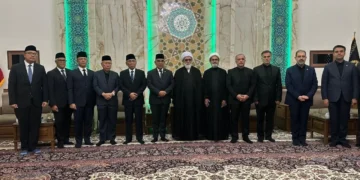
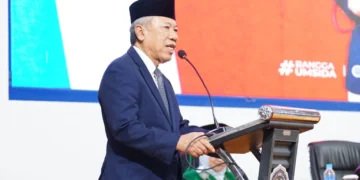
This was conveyed by Syafiq Mughni, Chairperson of Muhammadiyah Central Board, on Thursday (21/5). He delivered the message during an International Seminar organized by STAID Sadra in South Jakarta.
According to him, Muhammadiyah’s non-sectarian approach provides broader perspectives in addressing Sunni-Shia issues. It continues to emerge as points of debate among Muslims.
He explained that Muhammadiyah’s perspective is part of an effort to preserve the unity of the Muslim ummah so that it may become stronger. He noted that Muslims still long for unity in order to restore the glory of Islam in the past.
“We aspire for Islam to become a source of strength — certainly not an exclusive strength. Not a strength that exists only for itself, but a strength that contributes to building a safer and more just world,” he said.
A safer and more just world, he continued, is a pressing need and a hope shared by humanity today. Therefore, the strength and progress of Muslims are expected to help fulfill this long-awaited aspiration of mankind.
“This is certainly needed by all humanity, regardless of religion, affiliation, or school of thought within Islam,” he added.
In the seminar titled “The Contributions and Thought of Martyr Ayatollah Sayyid Ali Khamenei RA,” Syafiq explained the Iranian Revolution of the 1970s. He believed the historical event became a turning point that revived hopes among Muslims worldwide.
Ali Khamenei’s Leadership
The Professor of Islamic History stated that the Iranian Revolution was enthusiastically welcomed by the Muslim world. The main reason is not merely because of Iran itself, but more because it symbolized the defeat of the United States, which had long exercised hegemony over many Muslim societies.
One of the prominent figures to emerge from the Iranian Revolution was Ali Khamenei. Syafiq described Iran’s Supreme Leader as a comprehensive leader possessing intellectual, philosophical, ideological, and religious capacities.
“If we look at many countries today, most leaders are merely politicians or orators. They are none other than skilled speakers who are then elected president,” Syafiq remarked.
He further stated that Ali Khamenei could serve as a role model for future leadership. This is due to because of his scholarly, religious, philosophical, ideological, and political depth. According to him, the challenges facing the world in the future will become increasingly complex.
On the other hand, Syafiq observed that many contemporary world leaders often lack real capability. However, yet still attain power because they possess wealth or receive support from powerful financial backers.
Meanwhile, one of the lessons that can be drawn from the governmental system of the Iran, he added, is the absence of separation between religion and political life — where religion is not viewed as an obstacle to national progress.