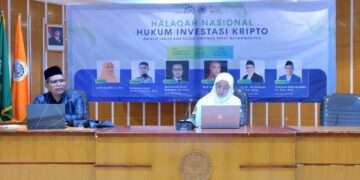


MUHAMMADIYAH.OR.ID, YOGYAKARTA—Muhammad Rofiq Muzakkir, Secretary of the Council for Religious Opinion and Reform of Muhammadiyah Central Board, has urged a reassessment of the council’s 2022 fatwa that declared cryptocurrency forbidden.

Speaking at a follow-up session of the National Halaqah on Crypto Investment Law at Ahmad Dahlan University on Saturday (28/2), Rofiq argued that Islamic legal thought must transform its understanding of property in the digital age.
One key argument behind the earlier prohibition was the absence of a physical underlying asset. However, Rofiq said that reasoning requires methodological review. The concept of an underlying asset, he explained, applies more clearly to instruments such as shares that represent ownership in tangible enterprises. By contrast, digital assets may constitute property in themselves.
“A digital asset itself is property (‘ain al-māl),” he said. “The issue is not the absence of a physical object, but how we understand evolving forms of wealth.”
He pointed to modern economic phenomena such as digital applications and domain names, which hold significant economic value despite lacking physical form. Moreover, he noted that fiat currencies have not been backed by gold reserves since the end of the gold standard in 1971. Therefore, making physical backing the sole criterion for permissibility appears inconsistent.
Volatility, Risk and Legal Structure
Rofiq also challenged the claim that high volatility automatically renders crypto unlawful. Price fluctuation, he argued, does not necessarily constitute gharar (prohibited uncertainty). Instead, it often reflects normal business risk.
“Nearly all commodities experience price swings,” he said. “Risk does not equal prohibition.”
In Islamic law, risk is inherent in economic activity as long as transactions remain free from fraud and contractual ambiguity. He compared crypto investment to restaurant businesses, many of which fail in their first year. That risk alone does not make the industry unlawful.
Addressing concerns about criminal misuse, Rofiq stressed that technology itself is neutral. While some illicit transactions involve crypto, the proportion remains small relative to global activity. Blockchain-based systems, he added, often provide greater transparency than cash transactions because they are traceable.
He further rejected the view that crypto lacks connection to the real economy. Through tokenization, real-world assets such as farmland or small enterprises can be digitally represented and partially owned by investors. Such models, he suggested, align with shared ownership concepts in Islamic commercial jurisprudence.
Literacy, Contracts, and Zakat Implications
Despite opening the door to permissibility, Rofiq emphasized caution. He warned against investing out of fear of missing out, noting that ignorance (jahalah) may turn investment into speculation or gambling. Independent research, he said, forms part of safeguarding wealth (hifz al-māl).
Not all cryptocurrencies will survive long term, he predicted. Therefore, investor literacy and market understanding remain essential.
Rofiq also linked crypto mechanisms to classical Islamic contracts. Proof of Work may resemble ju‘alah (a reward-based contract), while staking could fall under ju‘alah or wakalah when intermediaries are involved. Airdrops may qualify as gifts or reward contracts, but they become problematic if structured as loans generating profit, which risks riba.
Legal analysis, he stressed, must focus on the contractual structure rather than technological labels.
He agreed that cryptocurrency is unsuitable as legal tender due to instability as a unit of account. Indonesia’s ban on its use as payment, he argued, reflects administrative prohibition based on state regulation rather than intrinsic unlawfulness.
“As an asset, it may be acceptable under certain conditions. As currency, it remains unsuitable,” he said.
Finally, Rofiq suggested that crypto holdings could become subject to zakat if they meet the nisab equivalent of 85 grams of gold and are held for one lunar year. The rise of digital wealth, he concluded, requires renewed ijtihad so that zakat obligations evolve alongside modern economic realities.
Translator: Bintang Adrian