

MUHAMMADIYAH.OR.ID, BANTUL – For Palestinians, living under prolonged conflict, education has become a crucial investment in the future and a form of resistance that cannot be destroyed. In conditions of limited space and constant uncertainty, learning is a long-term strategy for survival and dignity.

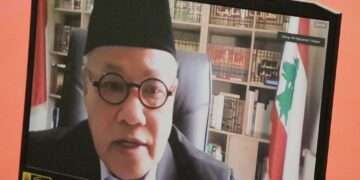
Al-Quds University President Prof. Dr. Imad Abu Kishek delivered the message during a guest lecture at Muhammadiyah University of Yogyakarta on Tuesday (13/01). Speaking to students, he emphasized that unlike land or housing, no one can seize education through occupation or violence.
“They can take lands and destroy homes. However, they cannot stole education from anyone,” Imad asserted.
n his lecture, “Life under Siege: Resistance and Hope for Palestine,” Imad explained that this perspective strengthened after 1967, when repeated territorial losses pushed Palestinians to seek resilience through knowledge. Since then, education has become a collective strategy to preserve identity, dignity, and national continuity.
According to him, many Palestinian families now place education at the center of their priorities. Schools and universities therefore have bold meanings beyond academic instruction, functioning as pillars of social endurance and future leadership.
Imad cited Al-Quds University as an example of knowledge-based resistance. Despite facing ongoing political and administrative pressure, the university continues to operate in Jerusalem. Its presence, he said, symbolizes determination to defend the right to education under occupation.
Maintaining academic quality under such constraints remains a challenge. However, Al-Quds University graduates continue to compete successfully at national and international levels, with degrees recognized through established evaluation systems.
“This shows that education is a sustainable form of resistance. Through knowledge, Palestinians build resilience without relying on physical force,” Imad explained.
A professor of public policy, he concluded by urging students to view education as a transformative tool to confront injustice, cultivate critical awareness, and promote humanitarian values and peace.
Translator: Bintang Adrian