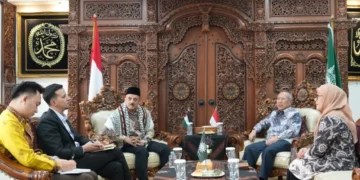


MUHAMMADIYAH.OR.ID, YOGYAKARTA – Proposals to relocate refugees from Gaza and other parts of Palestine, including ideas discussed in Indonesia, risk reinforcing long-standing political agendas rather than resolving the conflict, experts said during a public lecture at Universitas Muhammadiyah Yogyakarta.

Faris Al-Fadhat, a professor of international political economy at UMY, cautioned that humanitarian approaches must be examined through historical and political lenses. Without that perspective, he wanted, well-intentioned policies could produce unintended consequences.
“Humanitarian approaches must be read in their entirety,” Faris said. “If we are not careful, relocation of the Palestinian can actually strengthen the political agenda of emptying Palestine, which has long been a serious concern.
Faris stressed that the Palestinian issue cannot be separated from its historical context. Therefore, he argued, accepting refugees without addressing the root cause of displacement risks normalizing a process that benefits long-term territorial strategies.
Palestinian Relocation and the Politics of Displacement
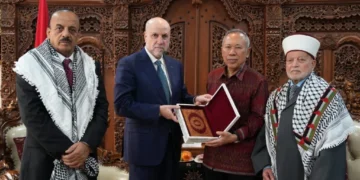
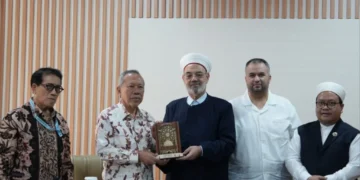
Responding to Faris’s remarks, Imad Abu Kishek, the president of Al-Quds University, firmly rejected relocation as a viable solution. Speaking at the guest lecture, titled “Life Under Siege: Resistance and Hope of Palestine,” Imad said displacement has been central to Israel’s strategy from the beginning.
“From the outset, the strategy has been to replace Palestinian society on its own land,” Imad said. “This strategy is systematic, and relocation often presents territorial emptying as if it were a humanitarian solution.”
According to Imad, forced migration rarely occurs through explicit orders. Instead, it unfolds through layered pressures that gradually make everyday life untenable. These pressures include restrictions on movement, economic hardship, administrative obstacles, and, ultimately, the criminalization of civilian life.
He noted that this pattern appears both in Gaza and in the West Bank. Palestinians, he said, are not told directly to leave. Rather, they are pushed out through conditions that are increasingly inhumane and unsustainable.
In the global context, Imad added, such practices often escape serious scrutiny. International media, he argued, frequently frame relocation as a pragmatic response to the crisis. As a result, the long-term consequences for Palestinian survival on their own land receive limited attention. (bhisma)
Translator: Bintang Adrian